On this page8 sections ↓Hide ↑
If you've noticed your organic traffic declining despite good SEO practices, there's a reason: AI search engines are answering queries before users ever reach your website.
ChatGPT, Perplexity, Google AI Overviews, and Gemini are now the first point of contact for millions of searches. The question isn't whether to optimize for them — it's how.
This page is the short version. If you want the complete playbook, examples, and tactical framework, read Generative Engine Optimization (GEO): The Complete 2026 Guide.
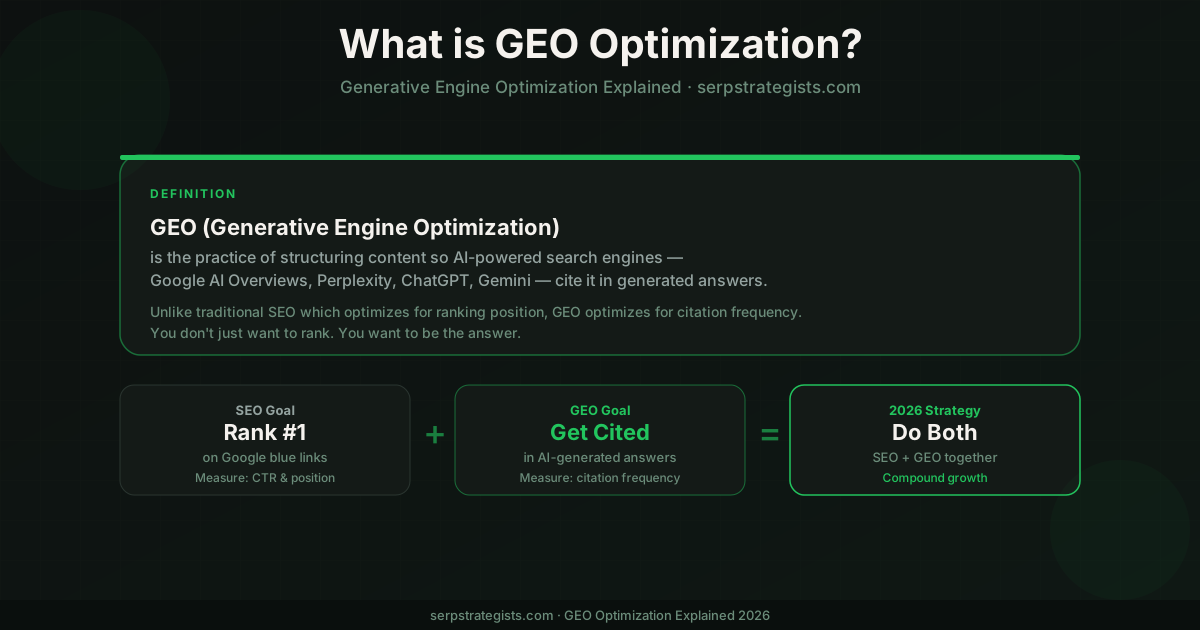
Generative Engine Optimization (GEO) Definition: Generative Engine Optimization (GEO) is the search optimization practice of structuring, substantiating, and formatting web content so that AI-powered search engines—such as Perplexity, ChatGPT Search, and Google AI Overviews—actively synthesize and cite your brand as an authoritative source in their conversational results.
The Core Concept of GEO
Traditional search optimization (SEO) focuses on moving your pages up the list of blue links on Google. Generative Engine Optimization (GEO) shifts the focus to citations and synthesis.
When a user prompts an AI search engine, the model reads, summarizes, and extracts key facts from several web documents. Your goal under a GEO framework is not just to be indexed, but to be the source that the model cites to prove its answer.
The one-sentence version
GEO is the discipline of making your content easy for answer engines to verify, quote, and attribute.
That means the page needs more than keywords. It needs:
- A clear answer near the top.
- Named entities that remove ambiguity.
- Claims supported by sources, examples, or first-party data.
- Tables, lists, and definitions that can be extracted cleanly.
- Author and brand signals that make the source trustworthy.
If a human has to read five paragraphs before understanding the answer, an AI system may also skip the page in favor of a cleaner source.
GEO vs. SEO: What's the Difference?
| Dimension | Traditional SEO | GEO |
|---|---|---|
| Primary Target | Google Search organic results | AI-generated answers & LLM engines |
| Ultimate Goal | Earn clicks and page visits | Earn citation links and brand mentions |
| Primary Signals | Backlinks, keywords, and page speed | Factual density, author credentials, structured data |
| Content Format | Comprehensive, user-facing pages | Modular, structured, easily synthesized blocks |
| Primary Metric | Organic ranking position & CTR | Citation frequency & conversational share-of-voice |
While traditional SEO builds the foundation of domain authority and index accessibility, GEO determines whether that authority translates into visibility inside conversational summaries.
Why GEO is Crucial in 2026
Conversational search is no longer a future trend. It represents a fundamental shift in search layout:
- Zero-Click Behavior: AI summaries solve informational queries instantly, reducing the need for users to click through to external websites.
- Citation Traffic: Conversational search platforms like Perplexity place citation cards prominently. Getting cited in these cards represents a high-conversion traffic source.
- Brand Authority: When AI models mention your product as a top recommendation, it builds massive brand trust.
For B2B SaaS, healthcare, and e-commerce brands, failing to optimize for generative citations means becoming invisible to a growing segment of searchers.
Is your site optimized for the AI search era?
Most sites are completely invisible to LLM crawlers. Get a free, comprehensive AI Search Visibility & GEO Assessment to see how ChatGPT, Claude, and Perplexity cite your brand, and receive a step-by-step roadmap to capture AI search share.
- Live citation share report (ChatGPT, Claude, Perplexity)
- Content formatting audit for LLM extraction
- 3 high-impact GEO actions you can run today
A quick GEO audit
Use this five-point check on any important page:
| Check | Pass signal | Weak signal |
|---|---|---|
| Answer clarity | The page answers the target question in the first 100 words | The answer is buried below context and opinion |
| Evidence | Claims are backed by examples, data, screenshots, or citations | The page makes broad claims with no proof |
| Extractability | Key ideas appear in lists, tables, definitions, or short paragraphs | The page is a long essay with no reusable blocks |
| Entity clarity | Brand, topic, product category, and audience are named consistently | The page uses vague terms like "this solution" repeatedly |
| Trust | Author, update date, contact, and policies are visible across the site | The source feels anonymous or stale |
Pages that fail two or more checks usually need a refresh before you create more content in the same cluster.
The Core Playbook: Definition vs. Execution
This page serves as a glossary definition. We keep this page focused strictly on explaining what GEO is and how it differs from SEO.
If you are ready to implement these changes, you need our operational guide. It contains code snippets, real before-and-after copywriting examples, structured tables, and step-by-step tactics:
👉 Read the Complete Strategy Guide: Generative Engine Optimization (GEO): The Complete 2026 Guide
Frequently Asked Questions
What does GEO stand for?
GEO stands for Generative Engine Optimization — the search optimization practice of structuring and optimizing content so that AI-powered search engines cite, quote, and summarize it in conversational answers.
What is the difference between GEO and SEO?
SEO optimizes for ranking position in traditional search results, while GEO optimizes for citation frequency in AI-generated answers. SEO focuses on blue-link clicks; GEO focuses on brand mentions and source links within conversational summaries.
Does GEO replace traditional SEO?
No. GEO complements traditional SEO. You still need search engine indexing, domain authority, and technical optimization to feed the crawlers. GEO is the formatting and structure layer that ensures the AI engine selects your content to synthesize.
Done reading?
If your team already owns the data but ships slowly, another dashboard rarely fixes that. The return comes from shortening the loop between insight and action. We'll show you how.
Related reading
- Generative Engine Optimization (GEO): The Complete 2026 Guide
- GEO vs SEO vs AEO: What's the Difference?
- How to Measure AI Search Visibility in 2026
- How to Appear in Perplexity AI Search Results
- Google AI Overviews: How to Actually Get Featured (Not Just Survive)
- Schema Markup for SEO: The Complete Guide to Structured Data in 2026
Done reading? is your site optimized for the AI search era?
Most sites are completely invisible to LLM crawlers. Get a free, comprehensive AI Search Visibility & GEO Assessment to see how ChatGPT, Claude, and Perplexity cite your brand, and receive a step-by-step roadmap to capture AI search share.
- Live citation share report (ChatGPT, Claude, Perplexity)
- Content formatting audit for LLM extraction
- 3 high-impact GEO actions you can run today
Written by

Aadil Khan
Founder & Organic growth operator
Aadil Khan is the founder of SERP Strategists. As an organic growth operator, he works with B2B SaaS and startup teams to scale search visibility using semantic engineering and data-driven GEO. Follow his experiments on LinkedIn or read our about page to see how we build.
How we build