On this page12 sections ↓Hide ↑
Search terminology is getting messy.
One person says SEO is still enough. Another says GEO replaces SEO. Another says you need AEO now. In practice, most teams are using overlapping language to describe different layers of the same shift in search behavior.
The useful question is not which acronym sounds newest. It is what each term is actually trying to optimize.
The short version
- SEO is about ranking in search results.
- AEO is about answering user questions clearly and directly.
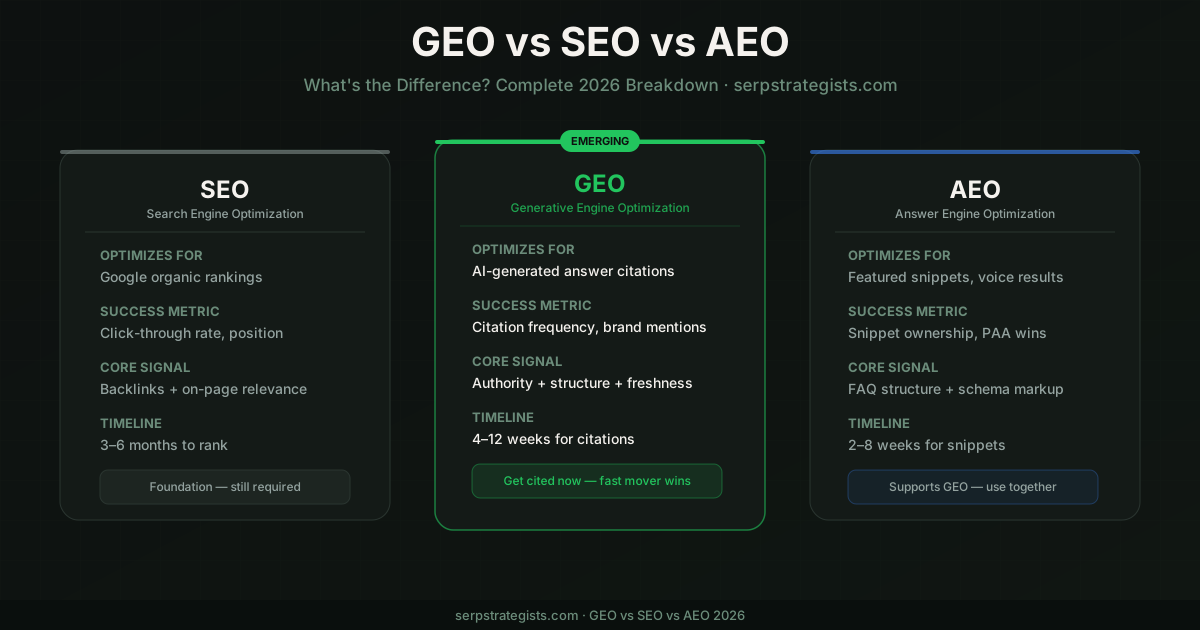
- GEO is about getting cited, summarized, or trusted by AI-generated answer systems.
You can think of them as connected layers, not mutually exclusive strategies.
What is SEO?
SEO, or Search Engine Optimization, is the discipline of improving a site so it ranks better in traditional search results and earns more qualified organic traffic.
Classic SEO still includes:
- crawlability and indexation
- keyword and query targeting
- internal links
- content quality
- backlinks and authority
- page experience and technical health
SEO is still the foundation. None of the newer acronyms remove the need for it.
What is AEO?
AEO, or Answer Engine Optimization, usually refers to structuring content so it can answer questions clearly in search experiences, voice assistants, rich results, and other answer-focused surfaces.
AEO tends to emphasize:
- direct question-answer formatting
- concise definitions
- FAQ structures
- schema markup
- snippet-friendly copy blocks
In practice, AEO is often the content-formatting layer that helps your information become easier to extract.
What is GEO?
GEO, or Generative Engine Optimization, is the practice of optimizing content so AI-driven systems like Google AI Overviews, Perplexity, ChatGPT Search, and Gemini can cite, synthesize, and trust it.
GEO tends to emphasize:
- self-contained answer blocks
- citations, statistics, and proof
- fresh and structured content
- strong topical clustering
- clear entities and authorship
- machine-readable supporting signals such as schema
If AEO helps content become easier to answer with, GEO helps it become easier to trust and include inside generated responses.
Where GEO, SEO, and AEO overlap
These disciplines share more foundations than people admit.
All three benefit from:
- strong technical health
- clear site structure
- topic relevance
- good internal linking
- well-structured content
- authority and trust signals
That is why the better strategy is usually not to replace SEO with a new acronym. It is to extend strong SEO with answer-ready structure and AI-citation readiness.
Where they actually differ
| Term | Primary goal | Main success signal | Typical format focus |
|---|---|---|---|
| SEO | Rank in search results | Clicks, impressions, rankings | Broad page quality and relevance |
| AEO | Answer a user question clearly | Snippet capture, answer extraction, rich result visibility | Direct answers, FAQs, definitions |
| GEO | Get cited in AI-generated responses | Citation presence, answer-layer visibility, brand mention | Structured, source-backed, quotable content |
The main difference is not whether one uses keywords and another does not. The difference is what outcome you are trying to create.
How teams should use the terms in practice
For most teams, a simple model is enough:
- Use SEO when talking about the full organic growth system.
- Use AEO when talking about answer formatting and extraction readiness.
- Use GEO when talking about AI search citations and answer-layer inclusion.
That keeps the language useful instead of turning it into marketing noise.
Which one matters most in 2026?
SEO still matters most because it is the base system. Without it, the newer layers are weak.
But the fastest-growing gap is usually between SEO and GEO. Many teams still publish pages that can rank, yet are hard for AI systems to quote, summarize, or trust. That is where structured answers, stronger evidence, and topic clusters matter.
If your team is already solid on classic SEO, GEO is the next leverage layer. If your pages are still weak on fundamentals, do not skip the base layer just because the newer acronym feels urgent.
Common mistakes
Treating GEO as a replacement for SEO
This usually leads to weak foundations and shallow content updates.
Treating AEO and GEO as identical
They overlap, but AEO is more about answer format, while GEO is more about citation and inclusion in generated answers.
Using new terminology without changing the content system
Renaming your strategy does not improve visibility. Better structure, stronger evidence, and better-supported topic clusters do.
Is your site optimized for the AI search era?
Most sites are completely invisible to LLM crawlers. Get a free, comprehensive AI Search Visibility & GEO Assessment to see how ChatGPT, Claude, and Perplexity cite your brand, and receive a step-by-step roadmap to capture AI search share.
- Live citation share report (ChatGPT, Claude, Perplexity)
- Content formatting audit for LLM extraction
- 3 high-impact GEO actions you can run today
FAQ
Is GEO different from SEO?
Yes, but not completely. SEO focuses on ranking and organic traffic. GEO focuses on getting cited or included inside AI-generated answers. GEO still depends on many classic SEO fundamentals.
Is AEO the same as GEO?
No. AEO is more focused on direct answer formatting and extractability. GEO is more focused on whether AI systems trust your content enough to cite or summarize it in generated responses.
Should teams do SEO, AEO, or GEO?
Most teams should do all three in layered form: SEO as the base, AEO for answer clarity, and GEO for AI-answer inclusion.
Which term should I use publicly?
Use the term that best matches the conversation. For broad organic growth, say SEO. For direct answer formatting, use AEO. For AI citation strategy, use GEO.
Final takeaway
GEO vs SEO vs AEO is not a winner-take-all debate. SEO remains the foundation, AEO improves answer clarity, and GEO improves AI-answer inclusion. The strongest strategy in 2026 is to understand the role of each and apply them together without confusing the terms.
Frequently Asked Questions: GEO vs SEO vs AEO
Is GEO replacing SEO in 2026?
No. GEO does not replace SEO — it extends it. Traditional SEO remains the foundation: without strong domain authority, crawlable site structure, and relevant content, GEO tactics will not produce consistent AI citations. GEO adds a layer on top of good SEO: it formats content for synthesis, adds attribution and structure, and builds the topical clustering AI systems use to decide who to trust on a topic. Both are necessary.
What is the difference between AEO and GEO?
AEO (Answer Engine Optimization) focuses on direct question-answer formatting for featured snippets, People Also Ask results, and voice search surfaces. GEO (Generative Engine Optimization) focuses on getting content cited inside AI-generated responses from ChatGPT, Perplexity, Google AI Overviews, and Gemini. In practice, AEO structure (FAQs, direct answers, schema) also helps with GEO. The goals differ slightly: AEO targets snippet capture, GEO targets AI citation. Most teams should pursue both.
Which is more important: SEO, AEO, or GEO?
For most teams in 2026, the priority order is: SEO foundation first, then GEO and AEO together. If your pages cannot rank in the top 10 for target queries, AI Overviews are unlikely to cite them. Fix your SEO foundation, then layer GEO structure: answer blocks, attributed statistics, FAQ schema, and topical cluster depth. AEO formatting (concise definitions, question-format headings) helps with both rankings and AI citations simultaneously.
What does AEO mean in digital marketing?
In digital marketing, AEO (Answer Engine Optimization) refers to the practice of formatting and structuring content so it can be extracted and displayed as a direct answer in search surfaces — including featured snippets, voice search results, Google’s People Also Ask panels, and increasingly, AI-generated answers. AEO tactics include: direct answer paragraphs near the top of pages, FAQ sections with schema markup, concise definitions, and numbered process lists. It was initially associated with voice search but has expanded to cover all answer-extraction surfaces.
How do I implement GEO, SEO, and AEO on the same page?
Use this layered approach: (1) Start with strong SEO fundamentals — clear title tag, target keyword in H1, quality content, and internal links from relevant pages. (2) Apply AEO formatting — answer the main question within 50 words of the H1, use question-format H2s, add a FAQ section with schema markup. (3) Layer GEO optimization — add one self-contained answer block of 40–60 words, include at least two attributed statistics, add expert quotes where relevant, and update the page’s modification date when you publish new content. This three-layer approach covers all three disciplines without requiring separate pages for each.
Related reading:
Done reading? is your site optimized for the AI search era?
Most sites are completely invisible to LLM crawlers. Get a free, comprehensive AI Search Visibility & GEO Assessment to see how ChatGPT, Claude, and Perplexity cite your brand, and receive a step-by-step roadmap to capture AI search share.
- Live citation share report (ChatGPT, Claude, Perplexity)
- Content formatting audit for LLM extraction
- 3 high-impact GEO actions you can run today
Written by

Aadil Khan
Founder & Organic growth operator
Aadil Khan is the founder of SERP Strategists. As an organic growth operator, he works with B2B SaaS and startup teams to scale search visibility using semantic engineering and data-driven GEO. Follow his experiments on LinkedIn or read our about page to see how we build.
How we build