On this page10 sections ↓Hide ↑
- 01Why Perplexity matters right now
- 02How Perplexity decides what to cite
- 03Tactical playbook
- 04Tracking your Perplexity citations
- 05What content types get cited most in Perplexity
- 06Perplexity vs Google AI Overviews: why citation works differently
- 07The competitive advantage
- 08Frequently Asked Questions: How to Appear in Perplexity
- 09Measure AI visibility with a repeatable scorecard
- 10From search insight to shipped execution
A friend texted me last week: "Dude, Perplexity just cited my blog post. I got 800 visitors from it in one day."
800 visitors. From a single Perplexity citation. On a blog with maybe 50 daily organic visitors.
That's the opportunity nobody's talking about.
Quick answer: To appear in Perplexity AI search results, publish answer-first content that directly responds to question-format queries. Use clear headings that match the question, include original data with attribution, add numbered lists and comparison tables, and keep your content updated at least monthly. Perplexity’s citation logic favors recency, specificity, and structured content over comprehensive but vague long-form articles.
Why Perplexity matters right now
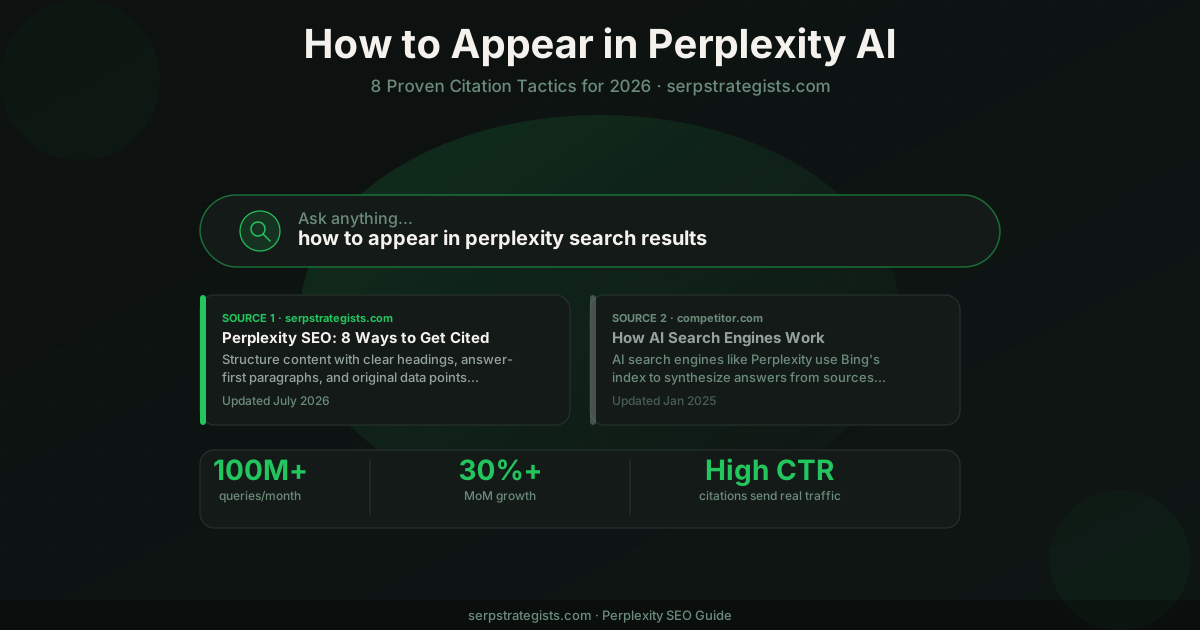
Perplexity is processing over 100 million queries per month. It's growing 30%+ month-over-month. Unlike Google, which increasingly answers queries without sending traffic, Perplexity actually links to sources prominently.
When Perplexity cites your content, users can see your URL right there in the answer. And they click. The CTR from Perplexity citations is dramatically higher than from Google's AI Overviews.
This is the rare case where an AI search engine actually sends traffic instead of stealing it.
How Perplexity decides what to cite
I've been studying Perplexity's citation patterns for months. Here's what I've observed:
1. Recency wins
Perplexity heavily favors recent content. A blog post from last week will often get cited over a more comprehensive post from last year. If you're writing about a topic that changes — update your content frequently.
2. Specificity beats generality
Perplexity doesn't cite generic overviews. It cites specific, detailed answers to specific questions. If someone asks "what's the best way to do X," it'll cite the post that gives the most direct, detailed answer — not the one that covers X as part of a broader topic.
3. Structured content gets parsed better
I've noticed Perplexity is much more likely to cite content that's well-structured:
- Clear headings that match the question being asked
- Numbered lists and bullet points
- Bold key facts and definitions
- Short, quotable paragraphs
4. Domain authority still matters
Perplexity uses Bing's index, and domain authority plays a role. But I've seen small, new sites get cited for niche topics where they're the only authoritative source. You don't need to be a DR 90 site to get cited.
5. Original data and unique insights
If your content includes original research, proprietary data, or insights you can't find anywhere else — Perplexity loves it. The AI is specifically looking for content that adds something the other sources don't.
Tactical playbook
Here's what I'd do to start appearing in Perplexity results:
Write "answer first" content
Start every section with a clear, direct answer. Don't bury the lead under three paragraphs of context. Perplexity wants to extract a clean answer and cite you for it.
Target question-based keywords
Perplexity users ask questions in natural language. Target queries like:
- "How to [do something]"
- "What is [concept]"
- "Best [thing] for [use case]"
- "[Thing A] vs [Thing B]"
Keep content fresh
Update your best posts at least monthly. Even small changes (updated stats, new examples, refreshed dates) signal freshness to Perplexity's crawler.
Add FAQ sections
I've noticed FAQ sections get cited disproportionately often. Add a FAQ to the bottom of every important post with 3-5 questions and clear, concise answers.
Make your content publicly accessible
This sounds obvious, but: no paywalls, no login gates, no content that requires JavaScript to render. Perplexity needs to crawl your content easily.
Tracking your Perplexity citations
Unfortunately, there's no "Perplexity Search Console" yet. But here's how to track:
- Check your referral traffic — Look for
perplexity.aiin your analytics referral sources - Search for your content manually — Ask Perplexity questions related to your content and see if you're cited
- Monitor brand mentions — Set up alerts for your domain being mentioned on Perplexity
If you want a wider framework that covers Perplexity, Google AI Overviews, ChatGPT, and Gemini together, start with the core playbook: Generative Engine Optimization (GEO): The Complete 2026 Guide, then continue to How to Measure AI Search Visibility in 2026.
What content types get cited most in Perplexity
Based on citation pattern analysis, these formats consistently appear in Perplexity answers:
| Content format | Citation frequency | Why it works |
|---|---|---|
| Numbered how-to guides | Very high | Easy to quote individual steps cleanly |
| Comparison tables | High | Structured data Perplexity extracts without losing context |
| Original statistics with source links | Very high | Unique data unavailable elsewhere |
| FAQ sections | High | Direct question-answer pair matches queries exactly |
| Definition paragraphs (40–60 words) | High | Quotable standalone answers Perplexity can lift verbatim |
| Case studies with named examples | Medium-high | Adds credibility and specificity |
| Long-form narrative essays | Low | Hard to extract a clean citation block |
| Paywalled or JS-rendered content | None | Perplexity’s crawler cannot access it |
The pattern is consistent: structured, specific, and quotable beats comprehensive and vague. A 600-word post with a clear answer, a table, and a FAQ section will often outperform a 3,000-word guide that buries the answer in paragraph four.
Is your site optimized for the AI search era?
Most sites are completely invisible to LLM crawlers. Get a free, comprehensive AI Search Visibility & GEO Assessment to see how ChatGPT, Claude, and Perplexity cite your brand, and receive a step-by-step roadmap to capture AI search share.
- Live citation share report (ChatGPT, Claude, Perplexity)
- Content formatting audit for LLM extraction
- 3 high-impact GEO actions you can run today
Perplexity vs Google AI Overviews: why citation works differently
Perplexity and Google use different citation logic, and your strategy should account for the difference:
| Dimension | Perplexity | Google AI Overviews |
|---|---|---|
| Index source | Bing + own crawler | Google’s index |
| Ranking dependency | Less tied to organic position | Strongly tied to top-10 ranking |
| Domain authority requirement | Lower — newer sites can get cited | Higher — authority sites dominate |
| Freshness weighting | Very heavy | Moderate |
| Citation visibility | Prominent inline links | Smaller source links below answer |
| Traffic sent | Higher CTR per citation | Lower CTR per citation |
| Speed of appearing | 1–4 weeks for new content | 4–12 weeks |
The key implication: Perplexity is the faster, more democratic win. You do not need to outrank the entire web for a query — you need to be the most specific and current answer for your niche topics. That is achievable for new sites and new posts.
Google AI Overviews require you to already be ranking in the top 10 for the query. If you are not there yet, fix traditional SEO first. If you are already ranking, layer GEO structure on top to get cited inside the Overview.
The competitive advantage
Here's what makes this exciting: almost nobody is optimizing for Perplexity specifically. Most content creators are still focused purely on Google.
That means the bar for getting cited is low right now. You don't need to outcompete every site on the internet. You just need to be the clearest, most specific, most up-to-date answer for your niche topics.
First-mover advantage is real here. The sites building Perplexity visibility now will have a massive lead as the platform continues to grow.
Frequently Asked Questions: How to Appear in Perplexity
How to show up in ChatGPT searches?
ChatGPT Search uses Bing’s index as its primary source. The tactics that work for Perplexity — specific answers, structured content, fresh updates, and original data — also help with ChatGPT citations. The main difference: ChatGPT is heavier on authoritative domains. Building more topical authority — a cluster of posts covering your niche comprehensively — matters more for ChatGPT than for Perplexity.
How many people use Perplexity in 2026?
Perplexity is processing over 100 million queries per month as of mid-2026, with 30%+ month-over-month growth. That is roughly 3 million queries per day. For comparison, Google handles approximately 8.5 billion searches per day — so Perplexity is a fraction of Google’s volume. But its user base skews toward research-heavy, high-intent queries, which means the traffic you get from a citation tends to be higher quality and more engaged than standard organic traffic.
What is the Perplexity controversy about scraping?
Perplexity faced criticism in 2024–2025 for summarizing publisher content without always providing sufficient attribution or traffic back to source websites. Several major publishers blocked Perplexity’s crawler. Perplexity has since introduced publisher revenue sharing through its Pro and API tiers. For most SEO-focused content creators, the controversy is now largely resolved — Perplexity cites sources prominently in its answers, and the traffic from a citation is real and measurable in your analytics referral data.
How to use Perplexity for SEO keyword research?
Perplexity is useful for checking what sources it currently cites for the queries you are targeting. Search your target questions in Perplexity, note which domains appear as cited sources, and analyze their content structure. Pages that Perplexity cites consistently have: headings that match the exact question, answer-first paragraphs (answer within 50 words of the heading), numbered or bulleted lists for processes, and a recent publication or update date visible on the page. Use those patterns as your content model.
Does domain authority matter for Perplexity citations?
Domain authority matters less for Perplexity than for Google. Because Perplexity applies its own freshness and specificity weighting on top of Bing’s index, small and new sites can get cited if their content is the most direct answer to a specific query. I have seen new domains (under 6 months old) with DR scores below 20 get cited by Perplexity for niche topics where they were the only authoritative and specific source. You do not need to be a high-authority domain to win on Perplexity.
Our AI agent optimizes your content for both Google and AI search engines like Perplexity. Start your free audit — see how AI-ready your content actually is.
Measure AI visibility with a repeatable scorecard
Do not rely on isolated screenshots or an unexplained visibility percentage. Use the AI Visibility Scorecard Template to track a stable prompt panel, mentions, citations, answer accuracy, Google generative-AI impressions, referral outcomes, and the exact changes shipped between measurement periods. The guide includes three downloadable CSV templates.
From search insight to shipped execution
SEO platforms and AI assistants can surface opportunities, but the work still needs prioritization, approval, execution, validation, and measurement. See how the SERP Strategists AI Growth Operator turns search data into governed, reviewable actions instead of another reporting backlog.
Done reading? is your site optimized for the AI search era?
Most sites are completely invisible to LLM crawlers. Get a free, comprehensive AI Search Visibility & GEO Assessment to see how ChatGPT, Claude, and Perplexity cite your brand, and receive a step-by-step roadmap to capture AI search share.
- Live citation share report (ChatGPT, Claude, Perplexity)
- Content formatting audit for LLM extraction
- 3 high-impact GEO actions you can run today
Written by

Aadil Khan
Founder & Organic growth operator
Aadil Khan is the founder of SERP Strategists. As an organic growth operator, he works with B2B SaaS and startup teams to scale search visibility using semantic engineering and data-driven GEO. Follow his experiments on LinkedIn or read our about page to see how we build.
How we build