On this page15 sections ↓Hide ↑
- 01The short answer
- 02The complete checklist: how to appear in Google AI Overviews
- 03What gets cited
- 04What does not get cited
- 05The citation-worthy paragraph
- 06Semantic completeness matters
- 07Structure matters more than ever
- 08Multi-modal content helps
- 09The GSC move
- 10What triggers Google AI Overviews?
- 11Why you might not be getting AI Overviews on your page
- 12What to update first
- 13My honest take
- 14Frequently Asked Questions: Google AI Overviews
- 15Measure AI visibility with a repeatable scorecard
Google AI Overviews are not magic. They are answer surfaces that prefer pages with clear definitions, complete coverage, and proof the claims are real.
If you want the short answer: publish pages that answer the query directly, support the answer with current sources, and make every important section easy to lift into a summary.
Quick answer: To appear in Google AI Overviews, your page must first rank in the top 10 for the query (pages outside the top 10 appear in AI Overviews only about 15–20% of the time). Once you rank, add a direct 40–60 word answer near the top of the page, use question-format H2 headings, add FAQ schema, source every statistic, and include a comparison table or numbered steps. Freshness signals also matter — update the page when you add new content.
The short answer
To appear in Google AI Overviews, your page needs three things:
- A direct answer near the top.
- Enough supporting detail that the answer is complete on its own.
- Clear structure so Google can extract the right paragraph, list, or table.
That means answer-first writing, not vague SEO copy.
The complete checklist: how to appear in Google AI Overviews
Use this as your pre-publish and refresh checklist for every page you want cited:
Content structure
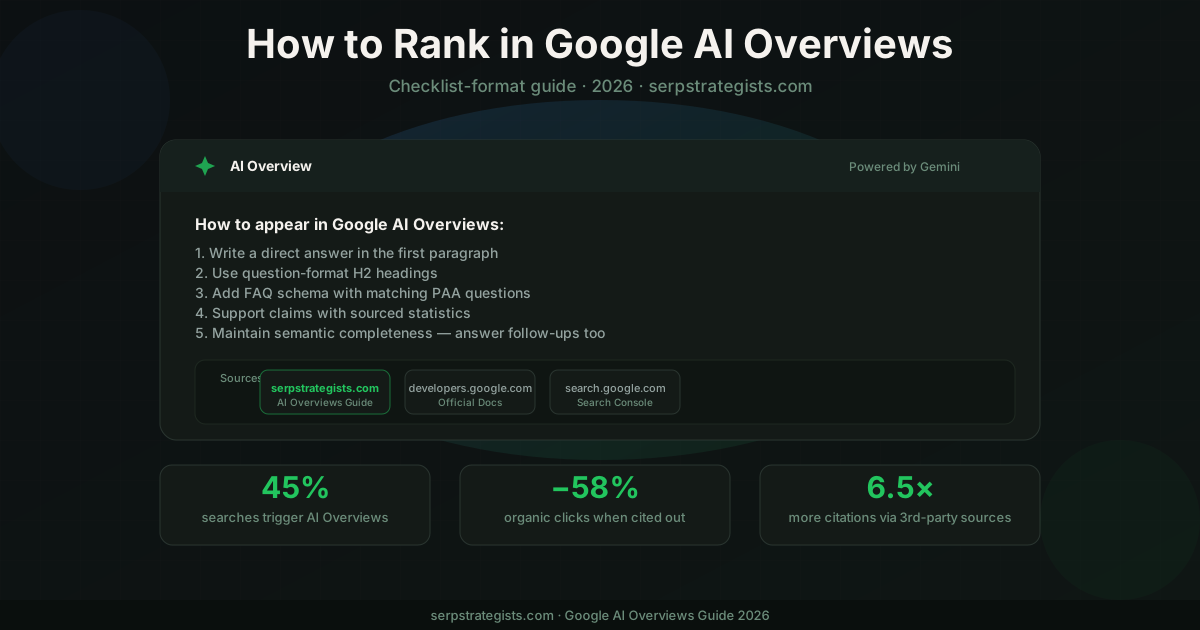
- Answer the query in the first paragraph — within 40–60 words of the H1
- Use H2 headings formatted as questions (e.g. “What triggers Google AI Overviews?”)
- Write at least one citation-worthy paragraph that stands alone without surrounding context
- Cover follow-up questions in the same page (semantic completeness)
- Add a numbered process list if the query is “how to”
- Add a comparison table if the query is “vs” or “best”
Technical and schema
- Add FAQ schema (JSON-LD) with real PAA questions for the topic
- Add HowTo schema if the page is a step-by-step guide
- Verify every statistic and link the source close to the claim
- Include your last-updated date visibly on the page
- Ensure the page is indexable and crawlable (check Search Console coverage)
Authority signals
- Link to 2–3 authoritative external sources (Google, academic, industry data)
- Include original data, proprietary insight, or firsthand experience
- List a clear author with visible credentials
- Ensure the page has at least 3–5 internal links from relevant cluster pages
What gets cited
Pages are more likely to be cited when they have:
- A question-focused title and H2
- A concise answer in the first paragraph
- Current data with visible sourcing
- FAQ blocks that match real search questions
- Comparison tables, numbered steps, and short definitions
- Strong entity clarity, so Google knows who and what the page is about
What does not get cited
AI Overviews usually skip pages that are:
- Thin sales pages with no real explanation
- Generic content that never answers the question directly
- Long intros that delay the actual answer
- Pages that rely on unsupported stats or stale claims
- Articles that make readers jump elsewhere for the basics
The citation-worthy paragraph
The easiest way to make a page quote-ready is to write one paragraph that stands alone.
It should:
- Answer one question.
- Include one concrete fact, number, or example.
- Make sense without the rest of the article.
Example:
A citation-worthy paragraph should define the idea, include one current supporting fact, and be short enough that Google can quote it without extra context.
That is the pattern AI systems can reuse.
Semantic completeness matters
The strongest pages do not just answer the headline question. They answer the follow-up questions too.
If the query is "how to rank in AI Overviews," the page should also explain:
- What gets cited
- What does not get cited
- How structure affects extraction
- How to refresh the page
- How to measure whether the update worked
That is semantic completeness. It is one of the biggest gaps on low-traffic pages.
Structure matters more than ever
Use a format that makes extraction easy:
- One direct answer near the top
- Question-style H2s
- Short lists for processes
- Tables for comparisons
- FAQ sections for related questions
- A last-updated date so freshness is obvious
You do not need to add more fluff. You need to make the existing answer easier to read and easier to quote.
Multi-modal content helps
Strong pages usually mix text with supporting formats:
- A simple table
- One chart or screenshot
- A short FAQ
- Structured data in JSON-LD
That combination gives Google more ways to understand the page and increases the odds that the page is selected for an AI answer.
The GSC move
Search Console is where the opportunity becomes visible.
Look for queries that trigger AI Overviews but do not cite your page. Then map each query to one section on the page:
- If the query is definitional, rewrite the opening answer.
- If the query is process-based, add numbered steps.
- If the query is comparative, add a table.
- If the query is freshness-sensitive, update the date and supporting facts.
Is your site optimized for the AI search era?
Most sites are completely invisible to LLM crawlers. Get a free, comprehensive AI Search Visibility & GEO Assessment to see how ChatGPT, Claude, and Perplexity cite your brand, and receive a step-by-step roadmap to capture AI search share.
- Live citation share report (ChatGPT, Claude, Perplexity)
- Content formatting audit for LLM extraction
- 3 high-impact GEO actions you can run today
What triggers Google AI Overviews?
Google AI Overviews appear most consistently for these query types:
- Definitional queries — “What is [X]?”, “What does [X] mean?”
- How-to queries — “How do I [task]?”, “How to [achieve something]?”
- Comparison queries — “[X] vs [Y]”, “Difference between [A] and [B]”
- Research and informational — multi-step questions that benefit from synthesis
- Medical, health, and financial queries (YMYL) — where AI synthesizes expert consensus
AI Overviews appear less frequently for: transactional queries (“buy [product]”), highly local queries (“restaurants near me”), and fresh news queries where no reliable synthesis is available.
Why you might not be getting AI Overviews on your page
The three most common reasons a page fails to appear in Google AI Overviews:
1. You’re not in the top 10 for the query. Pages outside the top 10 organic results appear in AI Overviews only 15–20% of the time. Fix your organic ranking first.
2. The page has no direct answer block. If your intro is three paragraphs of context before the actual answer, Google cannot extract a clean citation. Move the answer to the top.
3. The content is stale or lacks sources. Google’s AI layer is more aggressive about freshness than the organic ranking layer. A page last updated 18 months ago with no sourced statistics will lose citations to a fresher, more specific competitor page.
What to update first
If you are refreshing a low-traffic AI Overview page, do this in order:
- Rewrite the intro so it answers the query immediately.
- Add or tighten the citation-worthy paragraph.
- Replace vague subheads with real questions.
- Add a table or list where the page currently rambles.
- Verify every statistic and link the source close to the claim.
- Update the modified date when the page ships.
My honest take
AI Overviews are not going away. The sites that adapt fastest will keep their clicks or win more of them.
Most competitors are still writing generic SEO articles from 2023. That is the opening. If your page is specific, complete, and easy to cite, you can still win.
If you want a broader framework for measuring whether these AI surfaces are helping your site, read How to Measure AI Search Visibility in 2026.
If you want to see the trust and execution layer behind the updates, read Governance, Integrations and developer docs, and the Execution demo.
Frequently Asked Questions: Google AI Overviews
What triggers Google AI Overviews?
Google AI Overviews are most consistently triggered by definitional, how-to, and comparison queries. They appear for approximately 45% of all Google searches as of mid-2026, with the highest frequency on informational and research-intent queries. They appear less often for transactional, very local, or breaking-news queries. The safest trigger pattern is a clear question with an established answer that multiple authoritative sources agree on.
How do I get AI Mode to show on Google Search?
Google AI Mode (the upgraded AI-powered search interface) is available to users with a Google account in the US and several other markets. To enable it: open Google Search, look for the “AI Mode” tab at the top of the search results page, and click it. If you do not see it, your account may not have access yet as Google rolls it out progressively. Using Google Search Labs (labs.google.com) may also grant early access in supported regions.
Why am I not getting AI Overview on Google?
The most common reasons: (1) you are not searching from a supported region or account type, (2) the query type does not typically trigger AI Overviews (very local, transactional, or breaking news), (3) your content is not in Google’s top 10 for the query, or (4) your page’s structure makes it hard to extract a clean answer. Check Google Search Console for your query’s AI Overview impression data to confirm whether an Overview exists for the query at all.
How do I check if my content appears in Google AI Overviews?
Search your target queries directly in Google and look for the AI Overview panel at the top of results. Click “Show more” to see all cited sources. Also check Google Search Console under Search Results — filter by query and look at impressions alongside clicks. A high impression count with low CTR can indicate the query triggers an AI Overview that is absorbing clicks without citing your page.
Does FAQ schema help with Google AI Overviews?
Yes. Pages with FAQ schema (JSON-LD) that match real People Also Ask questions for the target query consistently receive more AI Overview citations. The schema helps Google map your Q&A pairs to specific sub-questions it needs to answer. Add FAQPage schema to every high-value page with 3–5 questions that match actual PAA questions shown for your target query in Google Search.
Want to know which of your pages are getting cited in AI Overviews and which are losing traffic to them? Get your free audit - we check AI Overview impact on every page.
Measure AI visibility with a repeatable scorecard
Do not rely on isolated screenshots or an unexplained visibility percentage. Use the AI Visibility Scorecard Template to track a stable prompt panel, mentions, citations, answer accuracy, Google generative-AI impressions, referral outcomes, and the exact changes shipped between measurement periods. The guide includes three downloadable CSV templates.
Done reading? is your site optimized for the AI search era?
Most sites are completely invisible to LLM crawlers. Get a free, comprehensive AI Search Visibility & GEO Assessment to see how ChatGPT, Claude, and Perplexity cite your brand, and receive a step-by-step roadmap to capture AI search share.
- Live citation share report (ChatGPT, Claude, Perplexity)
- Content formatting audit for LLM extraction
- 3 high-impact GEO actions you can run today
Written by

Aadil Khan
Founder & Organic growth operator
Aadil Khan is the founder of SERP Strategists. As an organic growth operator, he works with B2B SaaS and startup teams to scale search visibility using semantic engineering and data-driven GEO. Follow his experiments on LinkedIn or read our about page to see how we build.
How we build