On this page16 sections ↓Hide ↑
- 01SERP Intelligence topic map
- 02SERP competitor analysis worksheet
- 03Step 1: Define one query cluster
- 04Step 2: Capture the result-page context
- 05Step 3: Separate domains from ranking URLs
- 06Step 4: Build the competitor matrix
- 07Step 5: Diagnose the gap type
- 08Ranking gap vs CTR gap
- 09Step 6: Find information gain
- 10Worked example: improving our AI SEO pricing page
- 11Step 7: Score the candidate action
- 12Step 8: Choose one action and owner
- 13A 30-minute manual checklist
- 14Manual workflow vs operator workflow
- 15FAQ
- 16Final takeaway
SERP competitor analysis is not a list of brands. It is a repeatable way to inspect the URLs winning a query cluster, diagnose the real gap, and choose one improvement your team can ship and measure.
For a quick distinction between the software-selection, SERP-inspection, competitor-analysis, and benchmarking layers, read AI SEO Tools vs SERP Analyzers vs Competitor Analysis. This page owns the method and its output is a page-level action.
This page owns the method:
- Use Best SERP Analyzer Tools in 2026 when you need to choose the inspection tool.
- Use SEO Competitive Benchmarking in 2026 when you need an ongoing page and query-cluster program.
- Use Best AI SEO Tools in 2026 when you are choosing the broader stack.
The output of this guide is a page-level action, not another research folder.
SERP Intelligence topic map
This pillar owns the end-to-end competitor-analysis method. Use each supporting guide for one narrower job:
- SERP analysis template — capture query context, ranking URLs, page types, evidence, gaps, and the action owner in a reusable CSV.
- Best SERP analyzer tools — choose the live snapshot, history, location, authority, or export capability needed for inspection.
- Search intent analysis — decide what job the result set solves before changing a page.
- SERP feature analysis — record visible result elements, eligibility, user paths, and the correct response.
- Competitor content gap analysis — distinguish information and evidence gaps from authority, technical, and snippet problems.
- SEO competitive benchmarking — repeat the same page and query comparison over time.
The AI SEO Tools pillar owns software selection. This page begins after the evidence source or manual workflow has been chosen.
SERP competitor analysis worksheet
Copy this structure into a spreadsheet, CSV, Notion table, or database before starting:
| Field | What to record |
|---|---|
| Query | Exact query reviewed |
| Query cluster | Shared intent group |
| Date, location, device | Context of the result page |
| Rank | Position observed |
| Domain and URL | The exact competitor page |
| Page type | Guide, list, product, category, forum, video, tool, comparison |
| Search intent | Informational, commercial, transactional, local, navigational, mixed |
| SERP features | AI Overview, PAA, snippet, video, images, local, shopping, forum |
| Title and promise | How the result frames the answer |
| Freshness | Visible publish or update date |
| Proof | Data, screenshots, examples, quotes, customer evidence, references |
| Authority signal | Backlinks, brand strength, recurring domain presence |
| Internal support | Links from relevant pages or hubs |
| Weakness | Missing answer, weak UX, stale data, generic content, poor conversion path |
| Candidate action | The smallest useful change for your page |
For a CSV starter, use this header:
query,query_cluster,date,location,device,rank,domain,url,page_type,intent,serp_features,title_promise,freshness,proof,authority_signal,internal_support,weakness,candidate_action
Step 1: Define one query cluster
Do not begin with every keyword the business cares about. Start with one page and a small group of queries that share the same intent.
Example cluster:
- best SERP analyzer tools
- SERP analysis tools
- tools to analyze Google results
- SERP competitor-analysis software
Record the overlap before comparing content:
| Domain or URL | Query 1 | Query 2 | Query 3 | Query 4 | Appearances |
|---|---|---|---|---|---|
| Competitor A | Yes | Yes | No | Yes | 3 |
| Competitor B | Yes | No | Yes | Yes | 3 |
| Competitor C | No | Yes | Yes | No | 2 |
The pages appearing repeatedly are stronger cluster competitors than a famous brand that appears once.
Step 2: Capture the result-page context
A SERP snapshot without context is difficult to compare later.
Record:
- review date
- country or city
- language
- mobile or desktop
- logged-in or neutral browsing state where relevant
- visible result features
SERP features change the opportunity. A query with an AI Overview, People Also Ask, video carousel, and forum results may have fewer traditional clicks than a simple list of blue links.
Do not treat position 3 in two different SERP layouts as the same opportunity.
Step 3: Separate domains from ranking URLs
The exact URL is the unit of analysis.
For each result, classify:
- page type
- intent angle
- title promise
- opening answer
- structure
- freshness
- proof
- internal links
- authority support
A large domain may rank with a weak page because of authority. A smaller domain may rank because its page matches the intent precisely. Those situations require different responses.
Step 4: Build the competitor matrix
Use the same criteria for every ranking page.
| URL | Intent fit | Page type | Freshness | Original proof | Authority | Internal support | Main weakness |
|---|---|---|---|---|---|---|---|
| Competitor A | Strong | Tool comparison | Current | Pricing table | High | Strong | No execution guidance |
| Competitor B | Strong | Editorial list | Current | Screenshots | Medium | Medium | Weak methodology |
| Competitor C | Mixed | Generic guide | Stale | None | High | Strong | Does not help buyers choose |
| Your page | Strong | Tool comparison | Current | Workflow model | Low | Growing | Needs stronger external trust |
This matrix stops the analysis from collapsing into “they have more keywords” or “their domain is bigger.”
Step 5: Diagnose the gap type
Assign one primary gap before proposing a fix.
Intent gap
Your page type or promise does not match what the result page rewards.
Examples:
- a conceptual guide competing in a buying SERP
- a product page competing in a tutorial SERP
- a broad article competing against audience-specific pages
Content gap
The intent is correct, but the page lacks useful sections, evidence, examples, entities, or decision support.
Authority gap
The page is structurally competitive, but the ranking URLs have stronger links, brand trust, or topic history.
Technical gap
Crawlability, indexability, canonicalization, rendering, schema, speed, or internal links are weakening the page.
Snippet or CTR gap
The page already ranks, but its title and description do not earn enough clicks relative to the surrounding results.
Choose one primary diagnosis. Secondary gaps can be recorded, but the next action needs a clear reason.
Ranking gap vs CTR gap
These problems are often confused.
| Signal | Likely ranking gap | Likely CTR gap |
|---|---|---|
| Average position | Usually outside the useful click range | Already competitive |
| Impressions | May be growing as relevance improves | Often healthy |
| CTR | Low partly because position is weak | Low relative to a strong position |
| Main comparison | Page quality and authority versus winners | Search snippet versus nearby results |
| Typical action | Improve intent fit, content, links, proof, or technical support | Rewrite title and description without changing the core page |
Do not rewrite an entire article when the page already ranks and the main issue is a weak search promise. Do not polish a title when the page is structurally uncompetitive.
Step 6: Find information gain
Expected coverage is not differentiation.
Look for useful additions competitors do not provide:
- a decision matrix
- original data
- a worked example
- product screenshots
- a downloadable template
- a low-authority-site strategy
- a ranking-gap versus CTR-gap diagnosis
- an implementation workflow
- clear “choose when” and “avoid when” advice
- evidence showing how the recommendation was reached
The goal is not to make the page longer. It is to help the reader make a better decision or complete the task more reliably.
Deploy an autonomous operator to scale your search traffic
Stop manually managing complex SEO tasks. Request a tailored Organic Growth & Competitor Assessment—we'll perform a deep keyword gap analysis against your top 3 competitors and show you how an AI operator can execute approved SEO fixes on autopilot.
- Keyword gap audit vs. top 3 competitors
- Estimated traffic opportunity calculation
- 30-day autopilot execution plan
Worked example: improving our AI SEO pricing page
This is a real example from SERP Strategists, recorded on August 3, 2026. The target was our AI SEO tools pricing comparison, not a hypothetical page.
1. Start with first-party page evidence
We isolated the page's Google Search Console totals for July 17–August 1, 2026:
| Page evidence | Result |
|---|---|
| Impressions | 741 |
| Clicks | 0 |
| Average position | 18.6 |
| Window | 16 days |
The page totals are exact for that window. The export stores page totals and query totals separately, so it cannot prove that every site-level query belongs to this URL. That limitation matters: the evidence supports a page-level diagnosis, not a fabricated query-to-page join.
The first conclusion was therefore not “rewrite the title for CTR.” At an average position of 18.6, the page first needs stronger evidence and rankings before a CTR test can be interpreted cleanly.
2. Capture one reproducible live SERP
We ran the public AccuRanker Live SERP Checker with these settings:
- query: ai seo tools pricing
- location: United States — English
- device: desktop
- city: none
- session: fresh cloud browser, no signed-in Google account
- capture date: August 3, 2026
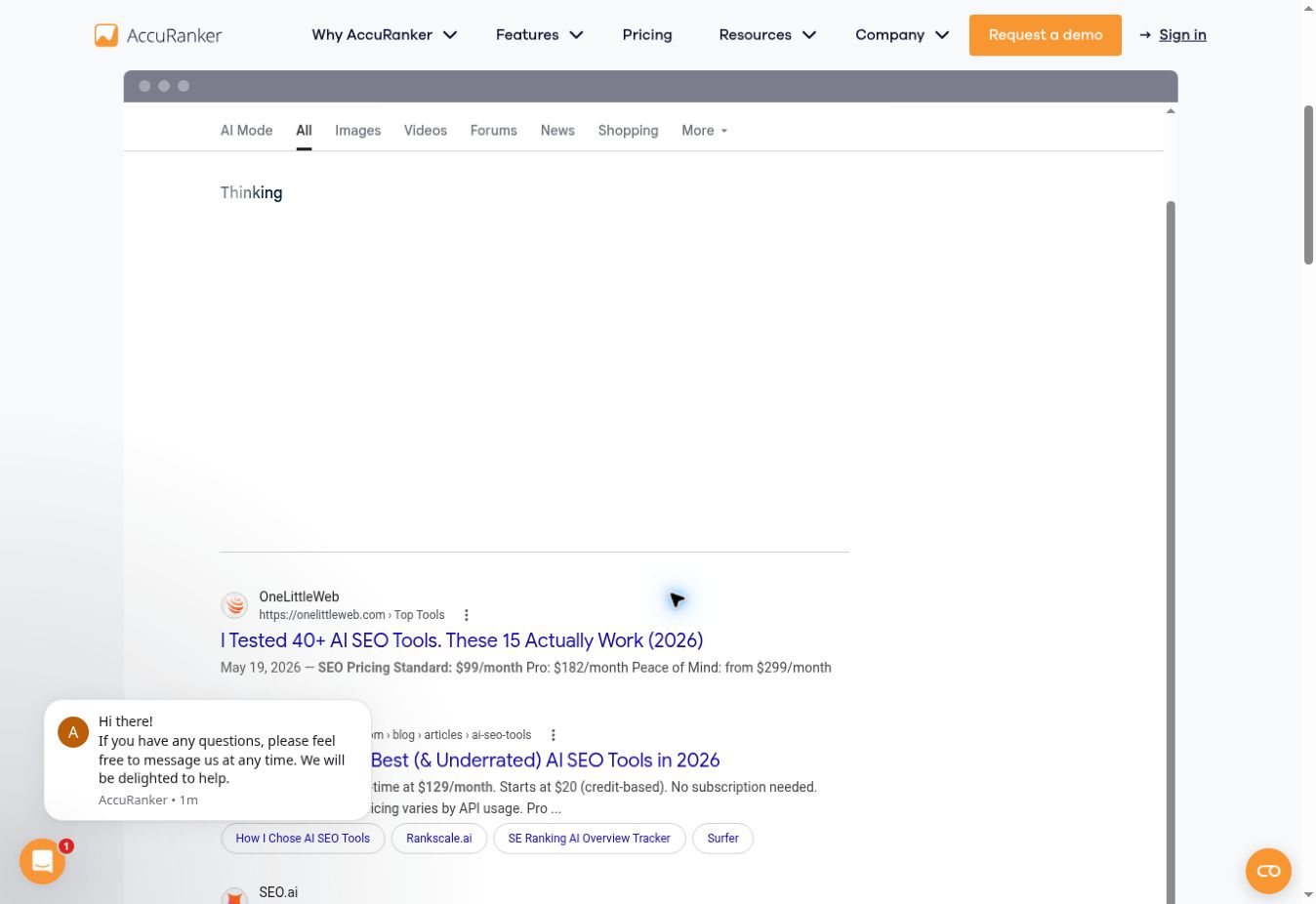
Evidence snapshot captured August 3, 2026. A live result page can change by time, location, device, and personalization; this is not rank history.
The first five organic results visible in that snapshot were:
| Position | Result | Page type | Evidence signal visible before opening |
|---|---|---|---|
| 1 | OneLittleWeb: “I Tested 40+ AI SEO Tools” | Tested editorial roundup | First-hand testing claim and a narrowed list |
| 2 | Whatagraph: “We Tested the 13 Best” | Tested editorial roundup | Testing-led title and curated tool count |
| 3 | SEO.ai pricing | Vendor pricing page | Direct transactional intent |
| 4 | Reddit discussion about fair AI SEO service prices | Community discussion | Peer pricing and service-buying intent |
| 5 | Tim Soulo: “12 Tools, Real Pricing” | Editorial comparison | Pricing-first promise, feature matrix, recommendations |
This SERP was mixed: tested comparisons, a vendor pricing page, a community discussion, and later video/editorial results all appeared. That means the query does not demand one rigid template. It does show a recurring expectation for real pricing, selection help, and visible proof.
3. Compare the evidence, not the word count
| Observation | Evidence | Diagnosis |
|---|---|---|
| Two leading editorial results foreground first-hand testing | Their titles and page introductions | Trust and experience are competitive requirements |
| A vendor pricing page ranks alongside editorial lists | SEO.ai in the visible top results | Direct commercial intent is present |
| Community and video results also appear | Reddit and YouTube in the result page | Buyers want both official facts and independent explanation |
| Our page averaged position 18.6 with no clicks | Page-level GSC totals | This is primarily a ranking/evidence problem, not a title-only CTR problem |
| Our broader tool guide already owns general “best tools” intent | Existing site architecture | Keep this page focused on prices, billing, limits, and cost drivers |
| Public prices change and annual equivalents are easy to misstate | Vendor pricing pages | Verification date and normalization method must be visible |
4. Choose the focused improvement set
The evidence led to six contained changes:
- Recheck public prices, billing cadence, usage units, seats, and add-ons against official vendor pages.
- Publish the verification method and state what was not tested behind a paid login.
- Add dated screenshots of representative pricing models.
- Add a feature-and-cost-driver matrix so readers can compare the unit that actually controls spend.
- Keep the existing URL and commercial intent instead of turning the page into another generic “best tools” article.
- Link the pricing decision to the separate SERP analyzer comparison and broader AI SEO tools guide.
The primary gap was proof. Authority still matters, so the content update should be paired with relevant internal links and outreach rather than treated as a guaranteed ranking fix.
5. Define the measurement window before shipping
We will compare the next complete 14–28 day window after recrawl against the pre-change baseline and record:
- qualified impressions and clicks
- average position for the page
- page-one impressions after excluding unrelated navigational and machine-shaped queries
- query expansion around pricing, billing, limits, and comparisons
- any change in audit starts from the page
A successful worked example does not end with “we published more content.” It ends with a dated hypothesis, a reversible change, and a defined outcome check.
Step 7: Score the candidate action
A simple score keeps the recommendation operational.
| Factor | 1 | 3 | 5 |
|---|---|---|---|
| Impact | Small supporting improvement | Meaningful page improvement | High-value page or cluster opportunity |
| Confidence | Weak evidence | Multiple supporting signals | Strong SERP, GSC, and page evidence |
| Effort | Large redesign or dependency | Several focused edits | Small, contained change |
| Risk | Could disrupt a winning page | Manageable and reversible | Low-risk, easy rollback |
One practical priority formula is:
priority = (impact × confidence) ÷ effort
Keep risk as a review flag rather than hiding it inside the score.
Step 8: Choose one action and owner
Useful outputs include:
- rewrite the search title and description
- add a decision table
- add missing proof or examples
- create a supporting article for a separate intent
- strengthen internal links
- fix a canonical or indexability issue
- add visible FAQ content and matching schema
- avoid the keyword because the authority gap is too large
Every action should include:
- affected URL
- evidence
- expected outcome
- owner
- approval requirement
- rollback approach where relevant
- measurement window
A 30-minute manual checklist
Minutes 0–5
- select one page
- select three to five queries with the same intent
- record location, device, and date
Minutes 5–15
- capture the top five URLs for each query
- mark recurring domains and URLs
- record page type, intent, and SERP features
Minutes 15–22
- compare title, opening answer, structure, proof, freshness, authority, and internal support
- identify the primary gap type
Minutes 22–27
- list no more than three candidate actions
- score impact, confidence, effort, and risk
Minutes 27–30
- choose one improvement set
- assign an owner
- define the measurement window
Stop when the decision is clear. More screenshots do not automatically improve the recommendation.
Manual workflow vs operator workflow
| Manual workflow | Operator workflow |
|---|---|
| Analyst collects and normalizes evidence | Connected sources populate a consistent evidence model |
| Findings live in a spreadsheet | Findings become scored opportunities |
| Someone creates tickets later | Approved actions enter the execution queue |
| Changes are difficult to trace | Actions, evidence, approvals, and outcomes are logged |
| Learning depends on analyst memory | Results can inform later prioritization |
SERP Strategists is designed for the second workflow, but the analysis standard should remain transparent enough to reproduce manually.
FAQ
How do I find my real SERP competitors?
Review a small query cluster and record the domains and exact URLs that recur. The real competitors are the pages repeatedly winning the same intent, not necessarily the companies your sales team considers direct competitors.
How many competitor pages should I analyze?
For a focused page update, the top five results across three to five closely related queries are usually enough to identify repeated patterns. Expand the sample only when the SERP is unstable or mixed.
What should I compare first?
Start with intent, page type, title promise, opening answer, SERP features, freshness, proof, authority, and internal-link support. These explain more than keyword density alone.
How do I know whether the problem is ranking or CTR?
Use Search Console. A page outside the useful click range usually has a ranking problem. A page with a competitive position and unusually weak CTR may have a snippet or promise problem.
What if competitors have much stronger authority?
Confirm that your intent and page structure are already competitive. Then target a sharper sub-intent, add original evidence, strengthen internal links, and build authority over time. Do not assume another content rewrite will close a large authority gap.
Final takeaway
A useful SERP competitor analysis has four outputs:
- the recurring competitors for one query cluster
- the primary gap type
- one scored improvement set
- an owner and measurement window
Use tools to collect evidence faster, but keep the decision understandable. The analysis is complete when the next action is specific enough to approve, ship, and measure.
Done reading? deploy an autonomous operator to scale your search traffic
Stop manually managing complex SEO tasks. Request a tailored Organic Growth & Competitor Assessment—we'll perform a deep keyword gap analysis against your top 3 competitors and show you how an AI operator can execute approved SEO fixes on autopilot.
- Keyword gap audit vs. top 3 competitors
- Estimated traffic opportunity calculation
- 30-day autopilot execution plan
Written by

Aadil Khan
Founder & Organic growth operator
Aadil Khan is the founder of SERP Strategists. As an organic growth operator, he works with B2B SaaS and startup teams to scale search visibility using semantic engineering and data-driven GEO. Follow his experiments on LinkedIn or read our about page to see how we build.
How we build