On this page11 sections ↓Hide ↑
- 01Pricing verification and disclosure
- 02AI SEO tools pricing comparison: current public entry points
- 03What the headline price usually leaves out
- 04Pricing details by tool category
- 05Example stack calculations
- 06How to compare total cost of ownership
- 07Questions to ask before purchasing
- 08FAQ
- 09Final takeaway
- 10Compare the best AI SEO tools for 2026
- 11From search insight to shipped execution
AI SEO pricing is difficult to compare because the number shown on a pricing card rarely represents the full cost.
One vendor displays a monthly price that is only available when the full year is paid upfront. Another charges per user. Another includes a limited number of prompts, documents, crawl credits, or tracked keywords and then sells additional capacity. Some products do not publish paid prices at all.
This guide compares the pricing models and public entry points that matter when choosing an SEO suite, content optimizer, crawler, AI assistant, or execution workflow.
For the broader product comparison, read Best AI SEO Tools in 2026. For result-page analysis capabilities, read Best SERP Analyzer Tools in 2026.
Pricing verification and disclosure
Last verified: August 3, 2026. Prices, plan names, limits, promotions, taxes, and regional currency conversions can change. Confirm the final checkout amount and contract terms on each vendor's official pricing page.
How we verified this comparison
We used the following method:
- Official sources only for prices and included limits. Each number comes from the vendor's public pricing or licence page linked in the table.
- One capture date. We checked the public pages on August 3, 2026, in a fresh browser session and saved representative screenshots below.
- Monthly and annual billing stay separate. A price described as “per month, billed annually” is a monthly equivalent, not a cancel-any-month subscription.
- Annual licences are not converted into pretend monthly plans. Screaming Frog, for example, sells a per-user annual licence.
- Usage units are treated as part of price. Seats, tracked keywords, crawl credits, prompts, documents, pages, API credits, and overages can materially change the bill.
- Non-public pricing stays non-public. We do not invent a paid price when the vendor requires a sales conversation.
- No affiliate weighting. Placement is based on product category and buying model, not commission or “cheapest tool” claims.
We did not complete checkout, calculate tax or currency conversion for every region, or open paid accounts to test every gated feature. The feature comparison is therefore a verification of publicly documented pricing and capacity, not a claim that we hands-on tested every paid product.
All prices below are in USD unless another currency is explicitly shown.
AI SEO tools pricing comparison: current public entry points
| Tool | Public entry price | Billing structure | Important limits or extra costs | Official source |
|---|---|---|---|---|
| Google Search Console | Free | No subscription | First-party data for verified properties; no competitor dataset | Google Search Console |
| Semrush SEO + AI Search | Free tier; paid SEO plan $139/month | SEO is $117.33/month when billed annually; Starter is $199 monthly or $165.17 annually; Pro+ is $299 monthly or $248.17 annually; Advanced is $549 monthly or $455.67 annually | SEO includes 5 websites and 500 tracked keywords; additional users start at $45/month; reports and lead-generation add-ons are separate | Semrush pricing |
| Ahrefs | Starter $29/month; full Lite plan $129/month | Lite $129, Standard $249, Advanced $449 monthly; Enterprise starts at $1,499/month with annual commitment | Lite publicly lists 5 projects, 750 tracked keywords, 100,000 crawl credits, 5 AI prompts and 1 included user; extra users and capacity add cost | Ahrefs pricing |
| Surfer | Discovery $49/month | Displayed prices are billed yearly: Standard $99/month, Pro $182/month, Peace of Mind $299/month; Enterprise starts at $999/month | Standard lists 360 content documents and 25 AI-visibility prompts checked weekly; documents, prompts, tracked pages, workspaces, refresh frequency and API access vary by tier | Surfer pricing |
| SE Ranking | Core $129/month | Core is $103.20/month billed annually; Growth is $279 monthly or $223.20 annually; Enterprise is custom | Core lists 10 projects, 2,000 tracked keywords, 100 AI prompts, 250,000 audit pages and 25,000 API credits; extra capacity and add-ons cost more | SE Ranking pricing |
| Clearscope | Essentials $129/month | Business $399/month; Enterprise custom | Essentials lists 50 tracked prompts, 50 pages, 20 Topic Explorations and 20 Drafts; extra pages and drafts are paid add-ons | Clearscope pricing |
| Frase | Starter $49/month | Starter $39/month annually; Professional $129 monthly or $103 annually; Scale $299 monthly or $239 annually; Enterprise custom | Starter lists 1 seat, 1 site, 10 articles and 50 audit pages; article, prompt, monitoring, seat and domain limits increase by tier | Frase pricing |
| Screaming Frog SEO Spider | Free for crawls up to 500 URLs | £199/year per user; not a monthly subscription | One licence is required per user; published bulk pricing is £189 for 5–9, £179 for 10–19 and £169 for 20+ licences | Screaming Frog licence pricing |
| MarketMuse | Free plan with 10 queries/month | Paid Optimize, Research and Strategy prices are not publicly listed | Paid tiers vary by tracked topics, briefs, strategy documents, users, inventory and queries | MarketMuse pricing |
| ChatGPT Business | $25/user/month on monthly billing | $20/user/month when billed annually, with a two-user minimum for the annual Business plan | General AI workspace rather than an SEO dataset; model and usage limits still apply | OpenAI business pricing |
| SERP Strategists | Free Growth Audit | Growth $49/month and Scale $99/month are early-access target prices, not active self-serve subscriptions | Final access, included limits, activation and billing are confirmed before launch; no paid-plan trial, annual discount or automatic overage pricing is published | SERP Strategists pricing |
The cheapest entry point is not automatically the cheapest operating model. A low subscription can still require another rank tracker, crawler, content tool, developer, editor, or agency to complete the work.
Verified feature and cost-driver matrix
This matrix uses the public plan named in the first column. It does not imply that unlike products are interchangeable.
| Public plan checked | Primary job | Included capacity verified on August 3 | Team or access model | Main cost driver |
|---|---|---|---|---|
| Semrush SEO | Broad SEO suite | 5 websites; 500 tracked keywords | Extra users from $45/month | Users, reports and add-ons |
| Ahrefs Lite | Research, links, rank tracking and audits | 5 projects; 750 tracked keywords; 100,000 crawl credits; 5 AI prompts | 1 included user | Extra users, projects and data |
| Surfer Standard | Content optimization plus AI visibility | 360 content documents; 25 prompts checked weekly | Capacity changes by tier | Documents, prompts and refresh frequency |
| SE Ranking Core | Rank tracking, audits, research and AI tracking | 10 projects; 2,000 keywords; 100 prompts; 250,000 audit pages; 25,000 API credits | 1 manager seat | Keywords, seats, projects and add-ons |
| Clearscope Essentials | Content optimization and monitoring | 50 prompts; 50 pages; 20 Topic Explorations; 20 Drafts | Unlimited users and projects are advertised | Extra pages and drafts |
| Frase Starter | Content briefs, optimization and AI visibility | 10 articles; 50 audit pages; 1 site | 1 seat | Articles, audits, prompts, sites and seats |
| Screaming Frog paid licence | Technical crawling | Unlimited URLs subject to machine resources and configuration | Per-user annual licence | Number of users |
| ChatGPT Business | General AI workspace | Workspace access; no native competitor keyword or backlink dataset | Per-user subscription | Seats and model usage limits |
Dated pricing evidence
The screenshots below preserve what three different billing models displayed during verification: a monthly SEO suite, an annual content platform and a per-user annual crawler licence. They are evidence snapshots, not permanent price guarantees.
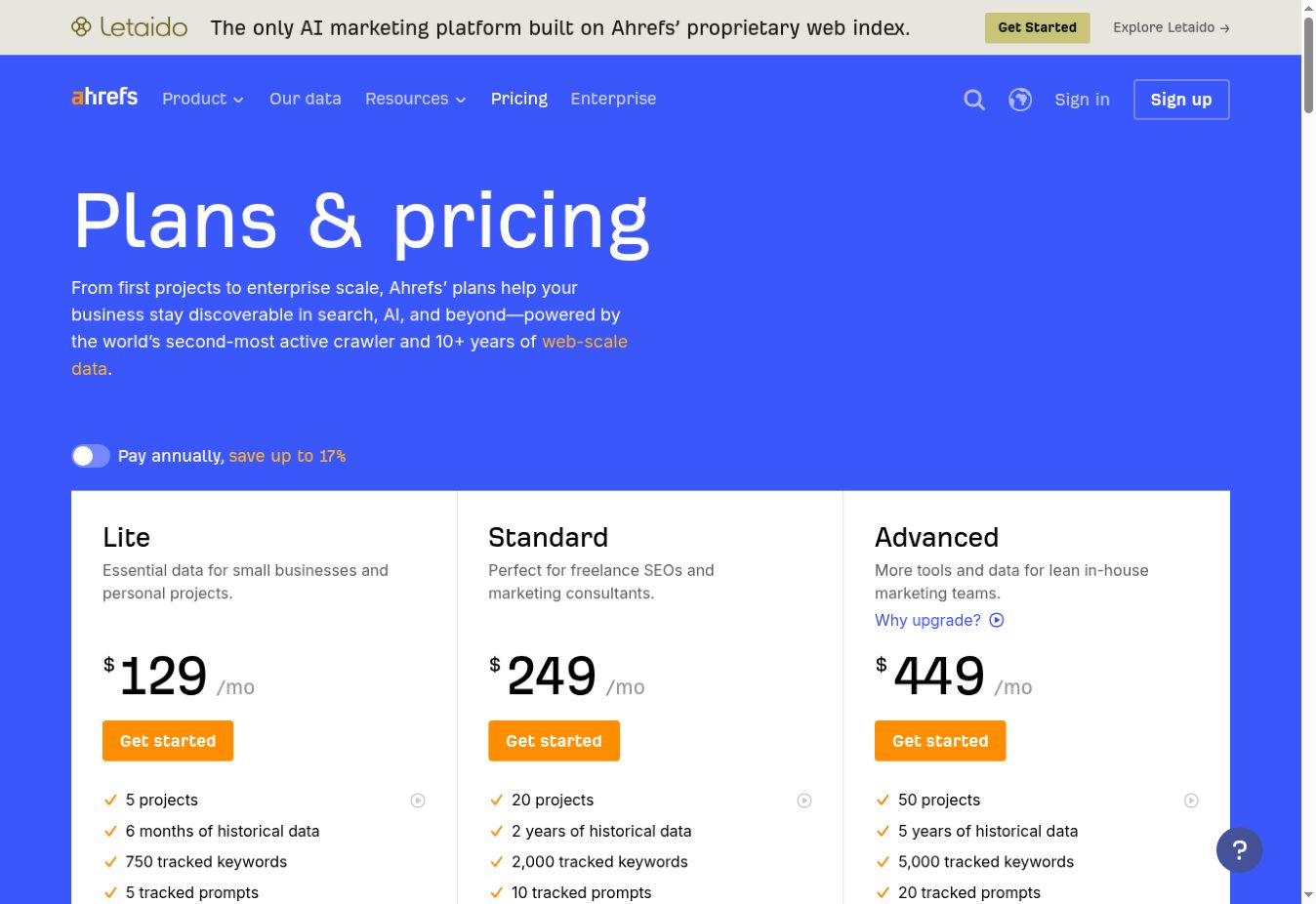
Ahrefs public plan cards on August 3, 2026. Verify the current amount and included capacity on the official pricing page.
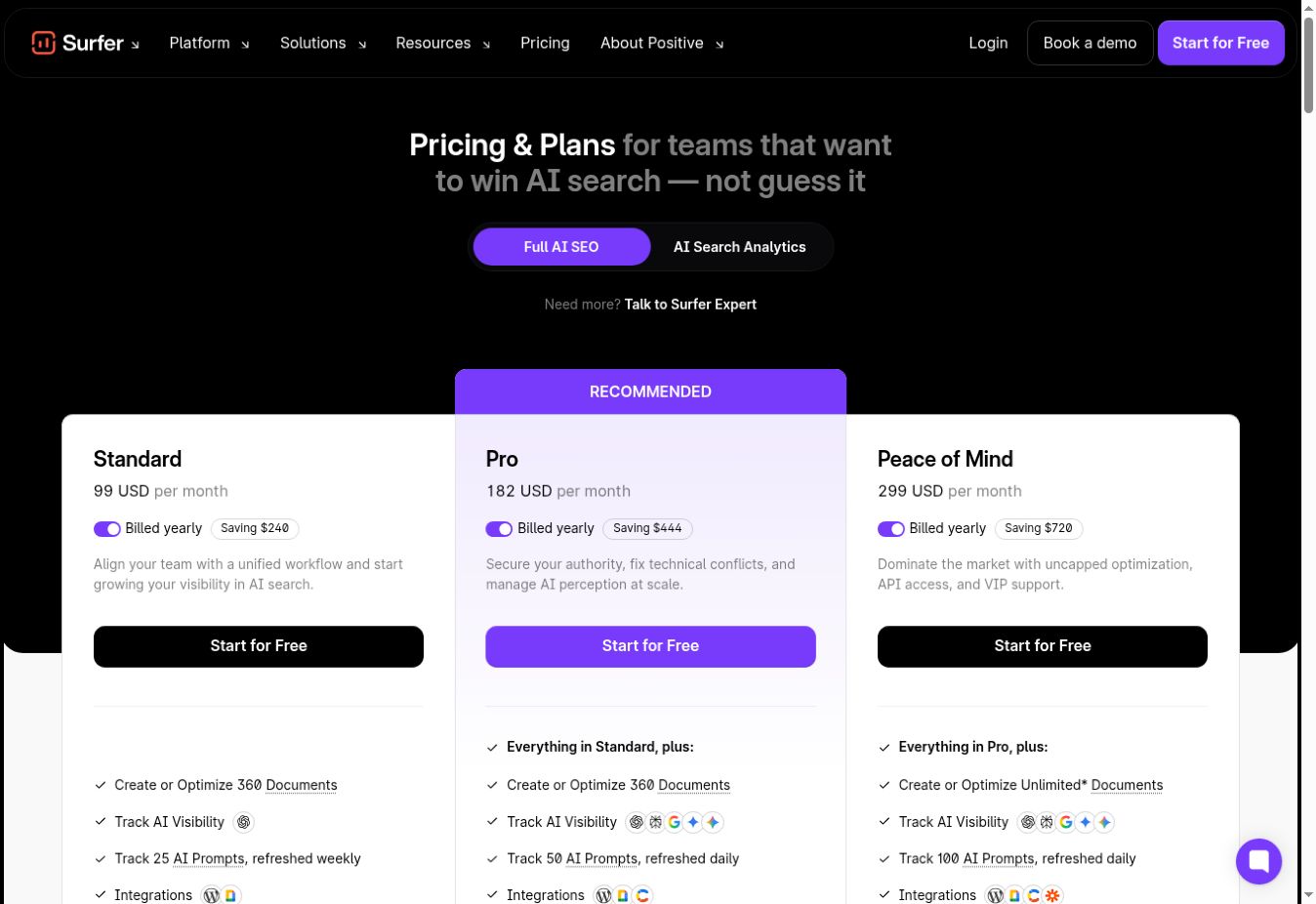
Surfer displayed monthly equivalents with annual billing on August 3, 2026. Verify current terms on the official pricing page.
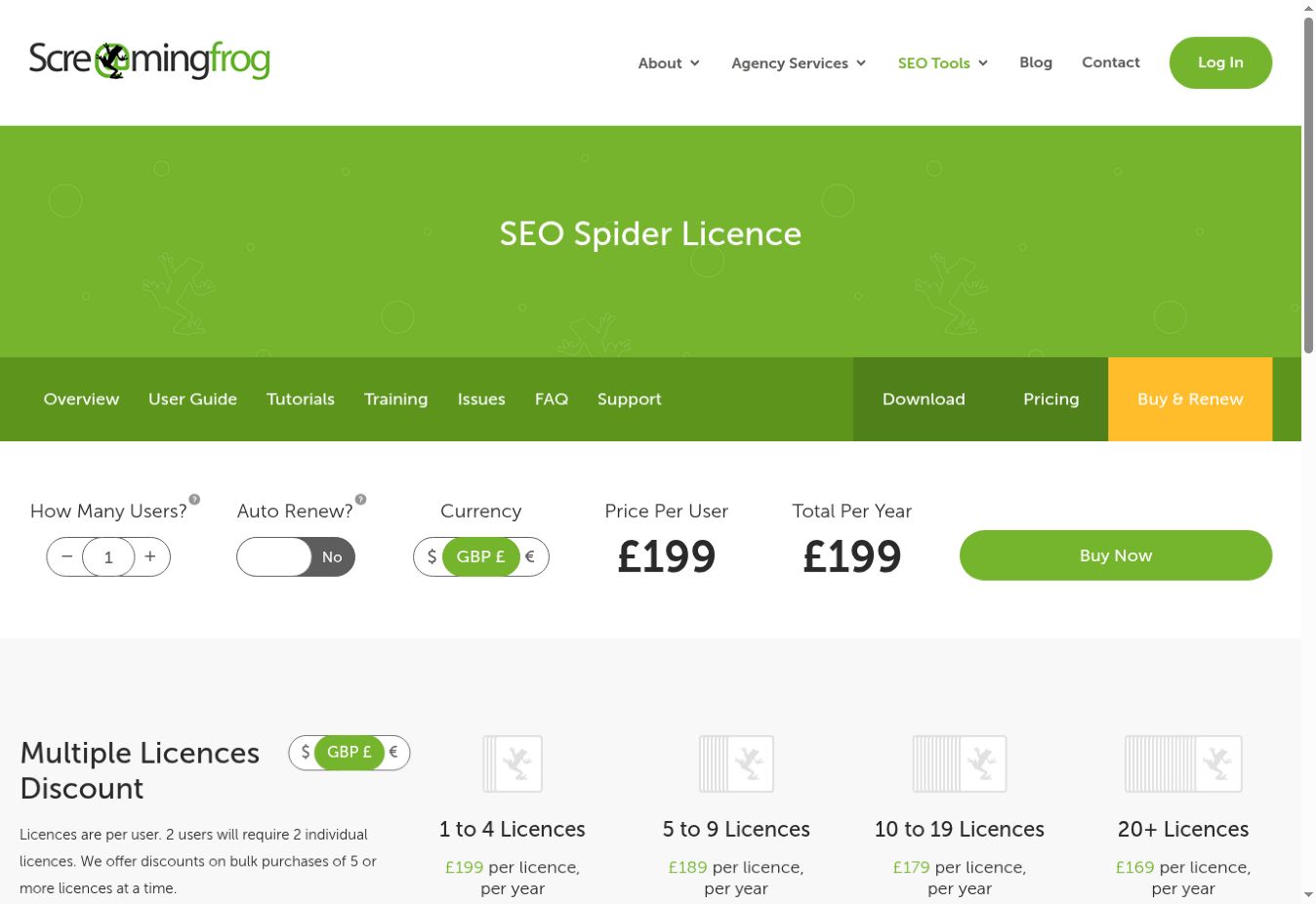
Screaming Frog's per-user annual licence and bulk tiers on August 3, 2026. Verify current terms on the official licence page.
Deploy an autonomous operator to scale your search traffic
Stop manually managing complex SEO tasks. Request a tailored Organic Growth & Competitor Assessment—we'll perform a deep keyword gap analysis against your top 3 competitors and show you how an AI operator can execute approved SEO fixes on autopilot.
- Keyword gap audit vs. top 3 competitors
- Estimated traffic opportunity calculation
- 30-day autopilot execution plan
What the headline price usually leaves out
1. Annual prepayment
A vendor may display $99/month while requiring the customer to pay the full year upfront. The monthly number is useful for comparison, but cash flow and cancellation flexibility are different from a true monthly plan.
Check for wording such as:
- billed annually
- annual commitment required
- paid upfront
- save 17% or 20% annually
2. Seats and users
Some tools include one user and charge for each additional person. Others include unlimited users but meter documents, pages, prompts, or credits instead.
A team of five should compare:
base plan + required seats + collaboration add-ons
—not only the single-user entry price.
3. Tracked keywords, prompts, pages, and documents
The relevant unit depends on the product:
- SEO suites meter projects, tracked keywords, crawl credits, exports, and API units.
- AI-visibility tools meter prompts, platforms, locations, domains, or checks.
- Content tools meter documents, drafts, pages, audits, or tracked topics.
- Crawlers may meter users rather than websites.
- Execution systems may meter connected sites and approved actions.
Before buying, estimate the volume you will use every month and compare it with the included capacity.
4. Add-ons and overages
Examples of costs that may sit outside the base plan include:
- additional users
- AI prompt packages
- API access or credits
- white-label reporting
- local-search locations
- extra tracked keywords
- extra pages or drafts
- pay-as-you-go content or model usage
- onboarding, migration, or enterprise support
Do not assume an advertised AI feature is included at the capacity your team needs.
5. Taxes and currency conversion
Taxes, VAT, GST, card conversion, and regional pricing can change the final invoice. Screaming Frog, for example, publishes a GBP base price and also supports USD and EUR pricing. Compare the actual checkout currency your company will use.
Pricing details by tool category
Broad SEO suites: Semrush, Ahrefs, and SE Ranking
Broad suites are usually the highest-value purchase when the team needs several of these in one account:
- competitor and keyword research
- rank tracking
- backlink data
- site auditing
- historical data
- reporting
- API or export access
- AI-search visibility monitoring
The cost becomes inefficient when the team uses only one narrow feature or already has equivalent data elsewhere.
Pricing decision: compare the plan that contains the required limits, not the vendor's lowest promotional or starter tier.
Content and AI-search optimization: Surfer, Clearscope, and Frase
These tools are easier to justify when writers and editors repeatedly create or refresh pages.
The most important cost units are:
- documents or articles per month
- pages monitored or audited
- tracked AI prompts
- domains and brand workspaces
- seats
- automated publishing or agent capacity
A plan can look inexpensive until the editorial calendar exceeds its document or audit limits.
Technical crawling: Screaming Frog
Screaming Frog has a different model from most SaaS subscriptions:
- the free version crawls up to 500 URLs per crawl
- the paid licence is annual
- each user needs a licence
- bulk discounts start at five users
That makes it inexpensive for one technical SEO operator but requires a separate calculation for a larger team.
Content strategy: MarketMuse
MarketMuse publishes the structure and limits of its Free, Optimize, Research, and Strategy plans, but does not display paid amounts publicly. The honest comparison is therefore:
- Free: public, limited to 10 queries per month
- Paid plans: contact/demo pricing
A comparison article should not insert an old third-party MarketMuse price as if it were current.
General AI assistants: ChatGPT
ChatGPT can support research, synthesis, clustering, drafting, and analysis. It does not include the same native keyword, backlink, crawl, or verified Search Console datasets as an SEO platform.
For a team comparison, ChatGPT Business is currently shown at:
- $25 per user per month on monthly billing
- $20 per user per month when billed annually
Its cost should be treated as an AI workspace layer, not a replacement for every SEO data source.
Execution workflows: SERP Strategists
SERP Strategists currently separates availability from target pricing:
- the free Growth Audit is available now
- Growth is a $49/month early-access target
- Scale is a $99/month early-access target
- joining early access does not start billing
- final limits and activation are confirmed before any paid account launches
This is deliberately different from presenting an unlaunched plan as a self-serve subscription.
Example stack calculations
These examples show how to structure the calculation. They are not universal recommendations.
Technical SEO operator
- Google Search Console: free
- Screaming Frog: annual per-user licence
- optional broad suite: add the plan that contains the required keyword, backlink, and historical-data limits
Main cost risk: multiple crawler users and unnecessary suite capacity.
Content team
- one content optimizer
- optional broad suite for keyword and competitor data
- general AI workspace for research and drafting
Main cost risk: document, page, prompt, domain, and seat limits across overlapping products.
Team with existing SEO data but slow implementation
- retain the current source-of-truth tools
- add an execution workflow only when it removes a measurable delivery bottleneck
Main cost risk: buying another dashboard instead of reducing time between evidence and a shipped change.
How to compare total cost of ownership
Use this formula:
annual base cost + seats + add-ons + expected overages + implementation time + service cost
Then measure the result against:
- hours of manual analysis removed
- number of actions shipped
- time from finding to deployment
- pages improved
- errors avoided through governance
- measurable click, ranking, crawl, conversion, or AI-visibility outcomes
A tool with a higher subscription can be cheaper if it replaces several overlapping products or significantly reduces implementation time. A cheap tool can be expensive if its output becomes another report no one acts on.
Questions to ask before purchasing
- Is the displayed monthly price available month to month, or only with annual prepayment?
- Which user, project, domain, keyword, prompt, page, document, and crawl limits apply?
- What happens at the limit: work stops, the plan upgrades, or overage charges begin?
- Are AI visibility, API access, exports, white labelling, and additional users included?
- Is the free trial automatic, and does it require a card?
- Can the plan be cancelled immediately, or only at the next renewal?
- Is the feature generally available, beta, an add-on, or restricted to enterprise?
- What other tools or people are still required to turn the output into a shipped change?
FAQ
What is the cheapest AI SEO tool?
Google Search Console is free for verified properties, and several vendors offer free or limited entry tiers. The cheapest useful option depends on the required job. A free first-party data source does not provide competitor backlinks, content optimization, or execution by itself.
What does “per month, billed annually” mean?
It is the monthly equivalent of an annual commitment. The customer normally pays the full annual amount upfront rather than paying that amount one month at a time. Always check the checkout total and cancellation terms.
Which AI SEO tools charge add-ons?
Many do. Common add-ons include users, AI prompt capacity, API credits, reports, white labelling, tracked keywords, local-search locations, pages, drafts, and content usage. The base plan should never be evaluated without the required add-ons.
Are the SERP Strategists paid plans available now?
The free Growth Audit is available now. The $49 Growth and $99 Scale prices are early-access targets for approved accounts, not active self-serve subscriptions. Joining early access does not start billing, and final scope and limits are confirmed before activation.
How often should a pricing comparison be updated?
Review volatile pricing pages at least quarterly and before any purchase recommendation. Update immediately when a vendor changes plan names, billing structure, included limits, or add-on pricing.
Final takeaway
Do not compare AI SEO tools using one number copied from the top of each pricing page.
Compare:
- the correct plan for your required workflow
- monthly versus annual commitment
- users and usage limits
- add-ons and overages
- the cost of the tools or people still needed after the recommendation is generated
The best-priced stack is the smallest combination that produces reliable evidence and consistently turns it into measurable work.
Compare the best AI SEO tools for 2026
Choosing between SEO platforms, content optimizers, AI visibility trackers, and execution tools? Read Best AI SEO Tools in 2026: 12 Tools Compared for a use-case comparison covering pricing models, strengths, limitations, and the best fit for SaaS teams.
From search insight to shipped execution
SEO platforms and AI assistants can surface opportunities, but the work still needs prioritization, approval, execution, validation, and measurement. See how the SERP Strategists AI Growth Operator turns search data into governed, reviewable actions instead of another reporting backlog.
Done reading? deploy an autonomous operator to scale your search traffic
Stop manually managing complex SEO tasks. Request a tailored Organic Growth & Competitor Assessment—we'll perform a deep keyword gap analysis against your top 3 competitors and show you how an AI operator can execute approved SEO fixes on autopilot.
- Keyword gap audit vs. top 3 competitors
- Estimated traffic opportunity calculation
- 30-day autopilot execution plan
Written by

Aadil Khan
Founder & Organic growth operator
Aadil Khan is the founder of SERP Strategists. As an organic growth operator, he works with B2B SaaS and startup teams to scale search visibility using semantic engineering and data-driven GEO. Follow his experiments on LinkedIn or read our about page to see how we build.
How we build