On this page18 sections ↓Hide ↑
- 01Quick comparison: SERP analyzer capabilities
- 02First-hand public-checker test: what completed and what did not
- 03What a SERP analyzer should inspect
- 04SERP analyzer vs adjacent tool categories
- 051. Ahrefs — best for authority-led SERP inspection
- 062. Semrush — best broad SERP and search-visibility platform
- 073. Surfer — best for content-pattern analysis
- 084. SE Ranking — best value all-in-one SERP workflow
- 095. Frase — best for brief-first SERP review
- 106. Screaming Frog plus manual browser review — best expert workflow
- 117. Google Search Console plus live SERP review — best first-party baseline
- 128. ChatGPT or Perplexity-assisted review — best for synthesis
- 139. SERP Strategists — best for governed action planning after analysis
- 14Decision guide
- 15FAQ
- 16Final recommendation
- 17Compare the best AI SEO tools for 2026
- 18From search insight to shipped execution
A SERP analyzer should answer a narrow question:
What is ranking for this query, what features shape the result page, and what evidence should change our page-level decision?
If you are choosing between the broader categories first, read AI SEO Tools vs SERP Analyzers vs Competitor Analysis. This page owns query-level inspection; the SERP Competitor Analysis Guide owns the interpretation and action method.
This guide compares tools for query-level SERP inspection. It does not try to rank every SEO platform feature or teach the complete competitor-analysis process.
- To choose a broader SEO, content, AI-visibility, or execution stack, read Best AI SEO Tools in 2026.
- To perform the analysis manually with a worksheet and worked example, use the SERP Competitor Analysis Guide.
- To benchmark pages and query clusters over time, use SEO Competitive Benchmarking in 2026.
Quick comparison: SERP analyzer capabilities
Last verified: August 3, 2026. Feature availability and limits vary by plan and can change. Confirm them on each vendor's official site before purchasing.
| Tool or workflow | Live SERP snapshot | SERP history | Location / device | SERP features | Ranking URL comparison | Authority context | Content-gap guidance | Export / API | AI-result visibility | Execution |
|---|---|---|---|---|---|---|---|---|---|---|
| AccuRanker public checker | Yes | No in the public check | Country; desktop or mobile | Visible in returned result page | URL list | No | No | No | No | No |
| Ahrefs | Yes | Strong | Varies by workflow | Good | Strong | Strong | Medium | Plan-dependent | Available in broader visibility products | No |
| Semrush | Yes | Strong | Strong | Strong | Strong | Strong | Medium | Plan-dependent | Strong broader AI-visibility coverage | No |
| Surfer | Yes | Limited focus | Limited focus | Content-focused | Strong for page patterns | Low | Strong | Limited | Available in broader product workflow | No |
| SE Ranking | Yes | Strong | Strong | Strong | Strong | Medium | Medium | Plan-dependent | Strong broader AI-search tracking | No |
| Frase | Yes | Limited | Limited | Content-focused | Strong for headings and questions | Low | Strong | Limited | Limited | No |
| Screaming Frog + browser | Manual | Manual | Manual | Manual | Strong with expert review | Requires another source | Custom | Strong exports | Manual | No |
| Google Search Console + browser | Manual | Your property only | Country / device in GSC | Manual | Your URLs only | No competitor authority | Your query gaps | Export / API available | Indirect signals only | No |
| ChatGPT / Perplexity-assisted review | Only when grounded in supplied sources | No reliable native history | No reliable live control | Can summarize supplied evidence | Useful for synthesis | Depends on sources | Useful for hypotheses | Workflow-dependent | Research assistance only | Low |
| SERP Strategists | Uses connected evidence | Depends on integrations | Depends on integrations | Converts findings into actions | Action-focused | Depends on sources | Action-focused | Workflow-dependent | Depends on connected checks | High |
The table separates analysis from execution. A tool can be excellent at showing the result page and still stop before the recommended change is approved, implemented, and measured.
First-hand public-checker test: what completed and what did not
We tested public SERP-checker flows on August 3, 2026. This was a usability and evidence-capture test, not a benchmark of proprietary rank databases.
Test protocol
- query: ai seo tools pricing
- location: United States — English
- device: desktop
- city: none
- browser: fresh cloud session with no signed-in Google account
- recorded fields: whether query, location and device could be set; whether a result returned without a paid account; what the public result exposed; and any verification wall
- safety rule: one normal attempt per checker; no CAPTCHA bypass or repeated verification attempts
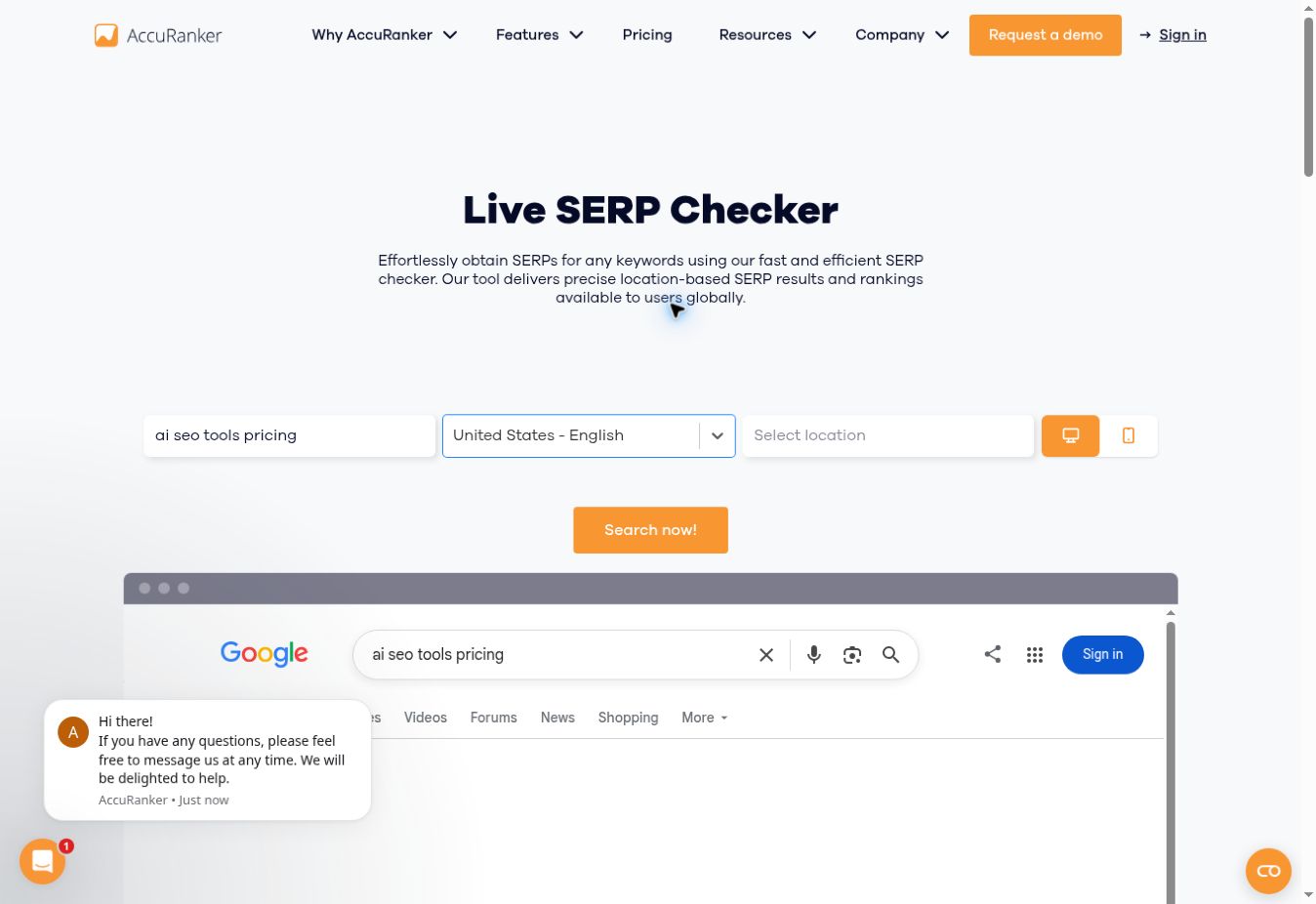
The reproducible setup used for the test: query, country-language and desktop device are visible in the capture.
Observed results
| Public checker | Observed outcome | What we could verify first-hand | What we could not verify |
|---|---|---|---|
| AccuRanker Live SERP Checker | Completed | The form accepted the query, US-English location and desktop device, then returned an embedded live result page with organic URLs and visible result features | Rank history, authority metrics, exports, API behavior and paid-plan accuracy |
| Semrush SERP Checker | Inconclusive in this session | The public form accepted query and location inputs | Human verification rejected the cloud session before results; we did not bypass it, so we do not score the result view |
| Ahrefs SERP Checker | Inconclusive in this session | The public form accepted query and location inputs | No completed result state appeared in the observed session, so we rely on Ahrefs' official documentation—not this attempt—for its documented metrics |
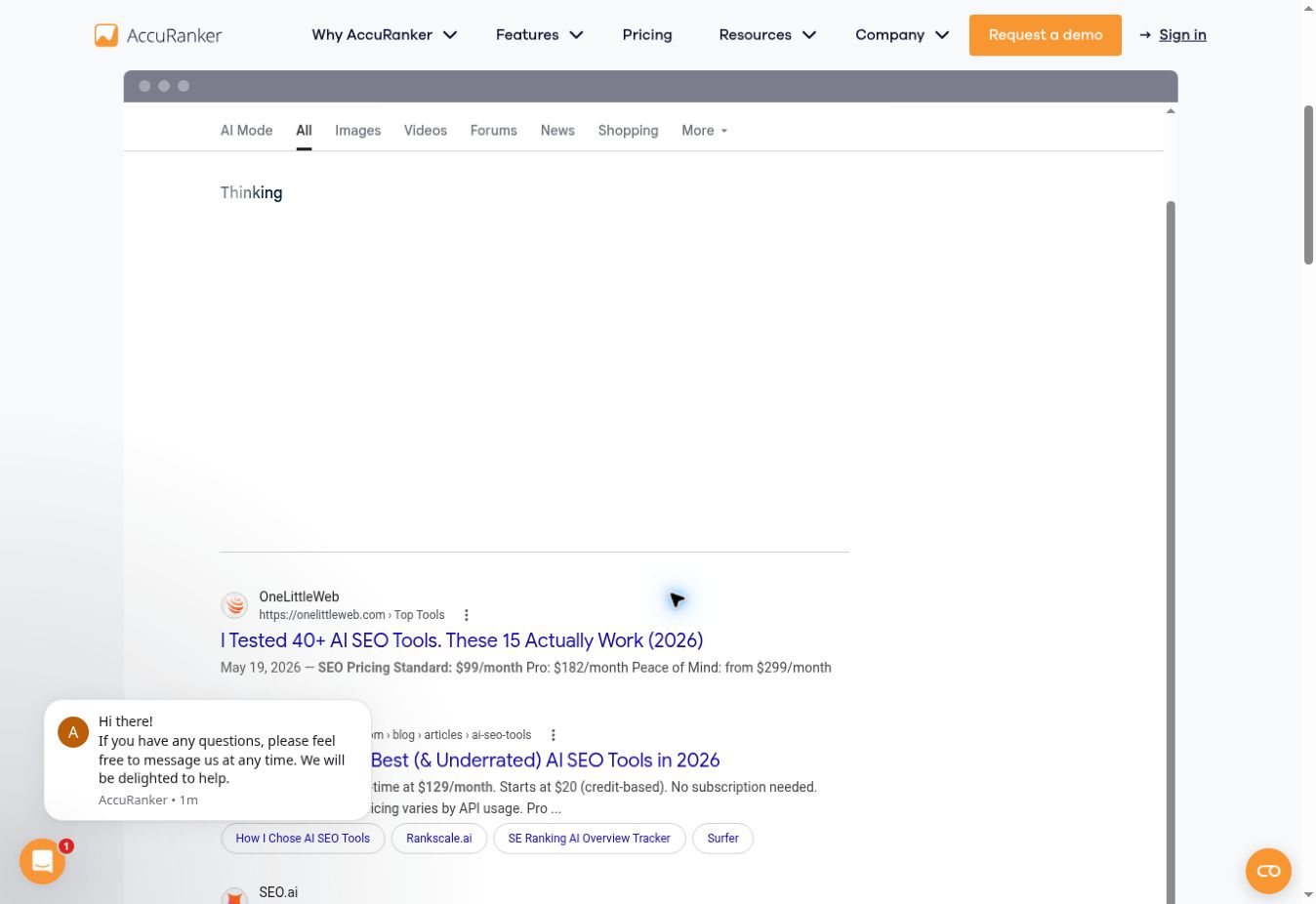
The completed AccuRanker snapshot showed a mixed result page with tested editorial comparisons, a vendor pricing page, a community discussion and video/editorial results. The full page-level interpretation is documented in the worked competitor example.
What this test proves—and what it does not
The completed check shows that a public SERP tool can preserve a dated, query-level snapshot without a paid login. That is useful for recording page types, titles, URLs and visible features.
It does not establish which paid platform has the most accurate history, strongest authority dataset or best API. One query in one country on one device cannot answer those questions. Result order can also change by time, location, device and personalization.
That is why the comparison below separates three evidence types:
- First-hand public-flow observations from the test above.
- Official feature documentation for paid capabilities we did not access.
- Operator judgment about where each tool fits in a workflow.
A blocked or inconclusive cloud session is recorded as a test limitation, not misreported as a product failure.
What a SERP analyzer should inspect
A useful SERP analyzer or manual workflow should capture:
- Ranking URLs, not only domains. The specific page type and format usually matter more than the company name.
- Intent and page type. Lists, guides, product pages, forums, videos, and category pages satisfy different jobs.
- Location and device. Results can differ across countries, cities, mobile, and desktop.
- SERP features. AI Overviews, People Also Ask, videos, images, local packs, shopping modules, and snippets change the click opportunity.
- History. A current snapshot can hide whether the result page is stable or frequently changing.
- Authority context. Backlinks, brand strength, and topical history determine whether a content-only fix is realistic.
- Page patterns. Titles, opening answers, comparison tables, examples, freshness, citations, and internal links can reveal the expected format.
- Exportability. Teams need to save the evidence, compare it later, and attach it to an action.
A content score alone is not a complete SERP analysis. A rank position alone is not a complete SERP analysis either.
SERP analyzer vs adjacent tool categories
| Category | Primary question | What it should own |
|---|---|---|
| Rank tracker | Where do we rank over time? | Position monitoring by query, location, and device |
| SERP analyzer | What is ranking now, and why? | Query-level result-page diagnosis |
| Content optimizer | What coverage may improve this page? | Briefs, entities, headings, and refresh guidance |
| SEO platform | What is happening across the domain? | Keywords, audits, backlinks, projects, and reporting |
| Competitor-analysis process | What gap should we act on? | Evidence collection, classification, scoring, and a page-level decision |
| SEO operator | What should we ship and measure? | Prioritization, approval, implementation, logs, and outcome tracking |
This page owns the tool-selection layer. The SERP Competitor Analysis Guide owns the step-by-step method.
1. Ahrefs — best for authority-led SERP inspection
Ahrefs is strongest when the key question is whether the URLs already ranking have an authority advantage your page cannot solve with content edits alone.
Choose when:
- competitor URLs and backlink profiles matter
- SERP history helps reveal result-page stability
- keyword difficulty needs page-level authority context
- you need to compare ranking pages before choosing a target
Avoid relying on it alone when:
- writers need an end-to-end editorial workspace
- the main problem is technical implementation
- the team expects approvals, publishing, and outcome tracking
Evidence: Ahrefs plans and pricing
Operator view: Ahrefs is useful for deciding whether a fight is realistic. It does not decide which approved change should ship first.
Deploy an autonomous operator to scale your search traffic
Stop manually managing complex SEO tasks. Request a tailored Organic Growth & Competitor Assessment—we'll perform a deep keyword gap analysis against your top 3 competitors and show you how an AI operator can execute approved SEO fixes on autopilot.
- Keyword gap audit vs. top 3 competitors
- Estimated traffic opportunity calculation
- 30-day autopilot execution plan
2. Semrush — best broad SERP and search-visibility platform
Semrush fits teams that want SERP inspection alongside keyword research, competitor analysis, rank tracking, audits, reporting, and broader AI-search visibility.
Choose when:
- location and device tracking matter
- multiple sites or clients need one reporting system
- competitor, audit, keyword, and visibility data should live together
- the team needs broader AI-visibility monitoring beyond a single result page
Avoid relying on it alone when:
- one page-level decision is getting buried in dashboard breadth
- the team only needs a lightweight content workflow
- findings already exist but implementation is delayed
Evidence: Semrush SEO and AI Search pricing
Operator view: Semrush offers breadth. The team still needs a decision rule that turns the evidence into one owned action.
3. Surfer — best for content-pattern analysis
Surfer is strongest when the team wants to compare the content patterns of ranking pages and translate those patterns into a page refresh.
Choose when:
- an existing article needs structured optimization
- writers need content-gap and topical guidance
- page patterns and expected coverage matter more than backlinks
- internal-link and content-audit workflows support the refresh
Avoid relying on it alone when:
- authority is the dominant ranking gap
- crawlability or indexability is unresolved
- copying averages would remove the page's original point of view
Evidence: Surfer pricing
Operator view: Use content-pattern evidence to identify expectations, then add original examples, proof, and judgment rather than reproducing the average result.
4. SE Ranking — best value all-in-one SERP workflow
SE Ranking is a practical option for teams combining rank tracking, SERP analysis, audits, competitor research, on-page analysis, and AI-search monitoring.
Choose when:
- daily rank and prompt tracking matter
- location and device views are part of the workflow
- a lean team needs broad functionality in one subscription
- audits and competitor checks should sit beside SERP data
Avoid relying on it alone when:
- the organization needs the deepest specialist dataset
- custom enterprise automation is mandatory
- implementation speed, not diagnosis, is the bottleneck
Evidence: SE Ranking plans
Operator view: It supplies many useful signals at a practical level. Someone still needs to score and own the resulting action.
5. Frase — best for brief-first SERP review
Frase is useful when the SERP review is primarily an input to a writer brief.
Choose when:
- headings, questions, and recurring topics need quick extraction
- the query is content-led
- writers need a faster first-pass outline
- the team understands that a synthesized brief is only a starting point
Avoid relying on it alone when:
- backlink and authority context determine feasibility
- technical blockers may explain the ranking problem
- the page needs original research rather than merged competitor coverage
Evidence: Frase
Operator view: Frase reduces manual briefing time. The strategic value still comes from deciding what not to copy and what new evidence to add.
6. Screaming Frog plus manual browser review — best expert workflow
A manual workflow remains valuable for unusual or high-stakes result pages.
Combine:
- a live browser review
- Screaming Frog for technical and page extraction
- Google Search Console for your verified query and page data
- a backlink or authority source when needed
- a worksheet that records the same fields for every ranking URL
Choose when:
- the SERP has mixed intent or unusual features
- tool recommendations disagree
- the page is tied closely to revenue
- technical template issues may be influencing performance
Avoid when:
- the team will collect evidence indefinitely without making a decision
- there is no owner for the resulting action
Evidence: Screaming Frog SEO Spider
Operator view: Manual review provides context automated scores miss, but it needs a fixed template and timebox to remain operational.
7. Google Search Console plus live SERP review — best first-party baseline
Google Search Console shows how your verified pages perform; a browser shows the competitors and features around them.
Choose when:
- you want to start with pages already receiving impressions
- query, page, country, and device performance matters
- you need to distinguish a ranking problem from a CTR problem
- budget is limited
Avoid relying on it alone when:
- competitor backlinks, authority, or estimated traffic are required
- historical competitor SERPs need to be reconstructed
Evidence: Google Search Console documentation
Operator view: GSC should anchor the opportunity. The live SERP supplies the competitive context that GSC does not contain.
8. ChatGPT or Perplexity-assisted review — best for synthesis
Language models can organize supplied SERP evidence, cluster repeated patterns, and turn notes into hypotheses.
Choose when:
- source material has already been collected
- repeated headings and themes need summarization
- a structured action draft will save analyst time
Avoid when:
- live ranking truth is being assumed without checking
- pricing, backlink, or indexation claims are not grounded in a source
- generated summaries would replace direct page inspection
Operator view: AI accelerates analysis. It does not create accountability or make an unverified result page current.
9. SERP Strategists — best for governed action planning after analysis
SERP Strategists is not positioned as a replacement for every SERP dataset. It is the operating layer after evidence has been collected.
Choose when:
- SERP findings need impact, confidence, effort, and risk scoring
- content, internal-link, schema, or technical actions need approval
- low-risk proposals should move through policy evaluation faster
- every approved change needs a log, validation plan, rollback thinking, and measurement window
Avoid when:
- the team needs only a standalone SERP snapshot
- the team requires live GitHub or WordPress execution today
- connected evidence sources and approval policies are not defined
Evidence: AI Growth Operator workflow
Current boundary: SERP Strategists can demonstrate the governed action and execution lifecycle through simulation. Live GitHub and WordPress adapters remain disabled.
Operator view: The SERP analyzer explains the result page. The operator turns the evidence into a reviewable action; external execution should be evaluated only when the relevant adapter is live and verified.
Decision guide
| Main question | Start with |
|---|---|
| Are ranking pages too authoritative? | Ahrefs |
| Do we need a broad SEO and AI-visibility system? | Semrush |
| Which content patterns should inform a refresh? | Surfer |
| Do we need a value-focused all-in-one workflow? | SE Ranking |
| Can we generate a writer brief faster? | Frase |
| Is the SERP unusual or technically constrained? | Screaming Frog plus manual review |
| Which of our pages already has evidence? | Google Search Console plus browser review |
| Can AI organize evidence we already collected? | ChatGPT or Perplexity-assisted review |
| How do we govern the resulting action? | SERP Strategists early access |
Before purchasing, use the SERP competitor-analysis worksheet on one real query. The missing capability will become clearer after a complete analysis pass.
FAQ
What is the best SERP analyzer tool?
The best choice depends on the missing evidence. Ahrefs is strongest for authority and backlink context, Semrush for broad SERP and visibility workflows, Surfer for content-pattern analysis, SE Ranking for a value-focused all-in-one workflow, and a manual browser plus crawler workflow for unusual result pages.
What is the difference between a SERP analyzer and a rank tracker?
A rank tracker records where a page ranks over time. A SERP analyzer inspects what is ranking for a query, which result features appear, how the winning URLs are structured, and why the current result page may reward them.
Do I need a paid SERP analyzer?
Not always. Google Search Console, a live browser review, and a consistent worksheet can produce useful analysis. Paid tools become valuable when you need SERP history, location and device controls, authority context, competitor data, or repeatable exports.
Do SERP analyzer tools help with AI Overviews?
They can record whether AI features appear and support the content and technical foundations that influence search eligibility. They do not guarantee inclusion. Google's guidance says the same foundational SEO practices remain relevant for AI Overviews and AI Mode.
What should happen after SERP analysis?
The analysis should end in one owned decision: update the current page, create a supporting page, strengthen internal links, fix a technical blocker, improve the search snippet, or avoid the query because the gap is not realistically winnable.
Final recommendation
Choose a SERP analyzer based on the evidence your team cannot currently collect—not on the number of dashboards included in the plan.
Then use the SERP Competitor Analysis Guide to convert that evidence into a page-level action. A useful SERP analysis ends with a decision, an owner, and a measurement window.
Compare the best AI SEO tools for 2026
Choosing between SEO platforms, content optimizers, AI visibility trackers, and execution tools? Read Best AI SEO Tools in 2026: 12 Tools Compared for a use-case comparison covering pricing models, strengths, limitations, and the best fit for SaaS teams.
From search insight to shipped execution
SEO platforms and AI assistants can surface opportunities, but the work still needs prioritization, approval, execution, validation, and measurement. See how the SERP Strategists AI Growth Operator turns search data into governed, reviewable actions instead of another reporting backlog.
Done reading? deploy an autonomous operator to scale your search traffic
Stop manually managing complex SEO tasks. Request a tailored Organic Growth & Competitor Assessment—we'll perform a deep keyword gap analysis against your top 3 competitors and show you how an AI operator can execute approved SEO fixes on autopilot.
- Keyword gap audit vs. top 3 competitors
- Estimated traffic opportunity calculation
- 30-day autopilot execution plan
Written by

Aadil Khan
Founder & Organic growth operator
Aadil Khan is the founder of SERP Strategists. As an organic growth operator, he works with B2B SaaS and startup teams to scale search visibility using semantic engineering and data-driven GEO. Follow his experiments on LinkedIn or read our about page to see how we build.
How we build