On this page15 sections ↓Hide ↑
- 01Quick comparison
- 02What an AI SEO agent should mean
- 03What an SEO agency should mean
- 04Compare total cost, not headline price
- 05Use a buyer-owned ROI worksheet
- 06Where an agentic workflow fits best
- 07Where an agency fits best
- 08When the hybrid model is better
- 09Questions to ask an AI SEO vendor
- 10Questions to ask an SEO agency
- 11Current SERP Strategists boundary
- 12Frequently asked questions
- 13Final decision
- 14Compare the best AI SEO tools for 2026
- 15From search insight to shipped execution
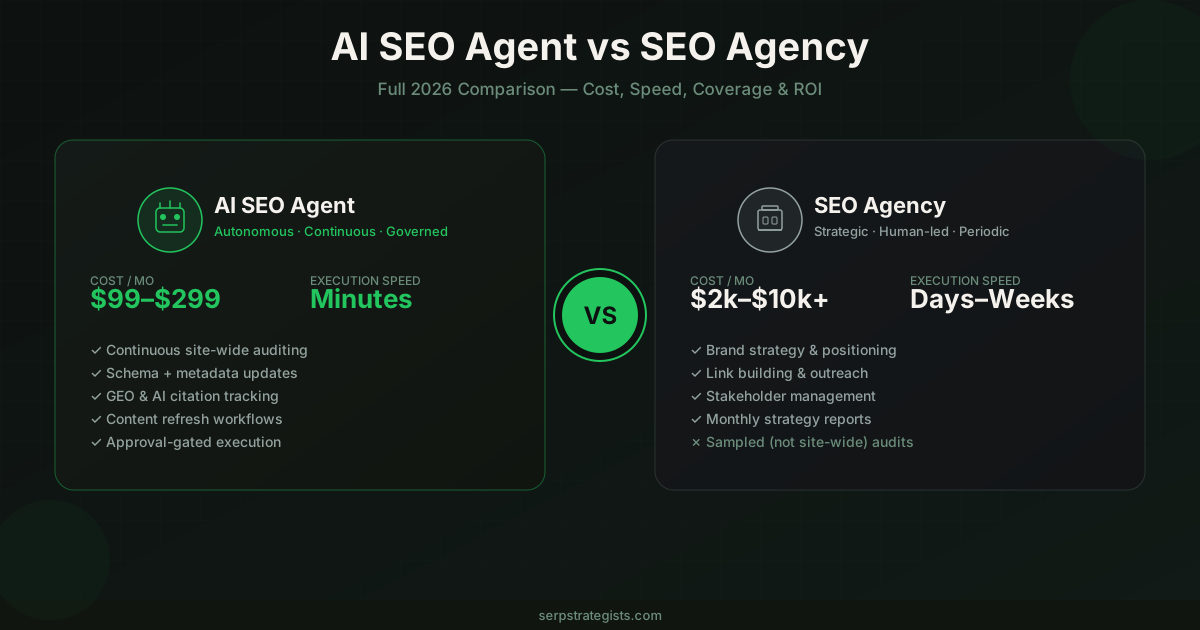
An AI SEO agent and an SEO agency are different operating models, not interchangeable products. Start with the AI SEO tools pillar if you are still choosing the software category. Use this comparison when the decision is software-led workflow, human service, or a hybrid of both.
The correct choice depends on the work, evidence access, risk, internal capacity, and implementation rights—not a universal claim that one model is faster or cheaper.
Quick comparison
| Decision factor | AI SEO agent or agentic workflow | SEO agency | Hybrid |
|---|---|---|---|
| Pricing model | Usually subscription, usage, seats, or managed platform fee | Usually project, hourly, deliverable, or retainer quote | Both cost structures |
| Best fit | Repeatable analysis, prioritization, drafting, monitoring, and controlled workflows | Strategy, stakeholder alignment, editorial judgment, outreach, and bespoke implementation | Repeated work plus human direction and exceptions |
| Data access | Limited to connected sources and permissions | Depends on access granted and agency process | Shared contract and source definitions required |
| Judgment | Encoded policies plus human review | Human practitioner judgment | Human policy owner supervises repeatable system |
| Implementation | Varies widely; may stop at recommendations, drafts, or simulations | Varies by statement of work and client access | Explicit ownership for every action |
| Governance | Product permissions, approvals, logs, and rollback where supported | Contract, process, review, and client approvals | Strongest when both use one audit trail |
| Main risk | Confident output without sufficient source grounding or safe execution controls | Slow handoffs, opaque work, inconsistent delivery, or retained knowledge | Paying twice without defining the handoff |
Never assume that the word agent means a product can safely publish to a live site. Verify every supported action, integration, permission, approval rule, validation step, and rollback path.
What an AI SEO agent should mean
An agentic workflow should connect multiple steps rather than generate one isolated answer. Depending on the product, those steps may include:
- collecting crawl, Search Console, analytics, ranking, or content evidence
- diagnosing a technical or content opportunity
- scoring impact, confidence, effort, and risk
- preparing a proposed change
- requesting approval
- executing through a supported adapter
- validating production
- measuring the outcome
Products differ significantly. Some only recommend. Some prepare drafts. Some can call external systems. Some use simulation to prove the lifecycle before live adapters are enabled. Compare documented behavior, not the category label.
What an SEO agency should mean
An agency is a service relationship with human responsibility defined by a statement of work. It may provide:
- market and search strategy
- technical audits
- content planning, editing, or production
- developer tickets or direct implementation
- digital PR and link outreach
- reporting and stakeholder communication
- experimentation and measurement
Agency scope also varies. One agency may deliver recommendations only; another may own implementation. Ask who changes the site, who validates production, and how work is measured.
Compare total cost, not headline price
Public software pricing and agency quotes use different units. A fair comparison includes:
AI agent or software cost
- base subscription or platform fee
- seats, sites, prompts, crawl credits, tracked keywords, or API usage
- setup and integration time
- human review and correction time
- required companion tools
- implementation work not included
- security and governance review
Agency cost
- retainer, project, or hourly fee
- deliverable and revision limits
- tooling passed through to the client
- developer or publisher time outside scope
- meetings and stakeholder coordination
- contract length and exit terms
- knowledge-transfer cost
Use the verified AI SEO pricing comparison for current public software billing structures. Request a written agency scope rather than using an unsourced “typical agency price” as fact.
Use a buyer-owned ROI worksheet
Fill this with your own numbers:
| Input | Current process | Agentic workflow | Agency | Hybrid |
|---|---|---|---|---|
| Monthly cash cost | ||||
| Internal hours required | ||||
| Pages or actions reviewed | ||||
| Approved actions completed | ||||
| Correction or rework hours | ||||
| Median time from evidence to production | ||||
| Failed or rolled-back changes | ||||
| Qualified clicks or conversions influenced |
Then calculate:
Net operating value
= verified internal cost removed
+ verified outside cost removed
+ value of additional useful work completed
+ value of preventable errors avoided
- cash cost
- setup, review, and correction cost
Do not assign revenue to a tool or agency merely because rankings changed after it was hired. Record the action, baseline, measurement window, and other material changes.
The 30-day AI SEO tool test gives you a controlled evaluation process.
Deploy an autonomous operator to scale your search traffic
Stop manually managing complex SEO tasks. Request a tailored Organic Growth & Competitor Assessment—we'll perform a deep keyword gap analysis against your top 3 competitors and show you how an AI operator can execute approved SEO fixes on autopilot.
- Keyword gap audit vs. top 3 competitors
- Estimated traffic opportunity calculation
- 30-day autopilot execution plan
Where an agentic workflow fits best
It is a strong candidate when:
- the same evidence-gathering task repeats frequently
- sources and permissions can be defined clearly
- proposed changes follow reviewable rules
- the team needs a prioritized queue rather than another raw report
- low-risk and high-risk actions can follow different approval policies
- implementation can be validated and logged
- outcomes can be measured against a baseline
It is a weak candidate when the work depends on negotiation, original relationships, ambiguous positioning, or judgment that cannot be reduced to a safe policy.
Where an agency fits best
An agency is a strong candidate when:
- the company needs an experienced strategic lead
- stakeholders need facilitation and persuasion
- editorial quality and brand positioning require sustained human judgment
- outreach and relationship-led authority building matter
- the implementation environment is unusual
- leadership wants accountable external ownership with a defined scope
An agency is a weak fit when it produces recurring audits that the client cannot implement or when the contract makes source data, changes, and outcomes difficult to inspect.
When the hybrid model is better
The hybrid model works when the handoff is explicit:
- Connected systems collect current evidence.
- The agentic workflow normalizes findings and proposes actions.
- A strategist reviews business fit, exceptions, and brand risk.
- The correct owner approves the change.
- A supported adapter, developer, editor, or agency implements it.
- Production is validated.
- Search and business outcomes are measured.
Without that contract, “hybrid” can mean duplicate reports and unclear ownership.
Questions to ask an AI SEO vendor
- Which data is first-party, licensed, inferred, or model-generated?
- Can every recommendation show its supporting evidence?
- Which actions are live, draft-only, simulated, or planned?
- What permissions does each integration require?
- Which changes require approval?
- How are before/after snapshots, validation, failures, and rollback handled?
- What usage units increase the bill?
- Can we export our data, action history, and outcomes?
Questions to ask an SEO agency
- Who performs the work and who reviews it?
- Does the scope include implementation or only recommendations?
- Which tools and datasets support the advice?
- Who owns the accounts, content, reports, and source files?
- How are technical changes approved and validated?
- Which outcomes are reported, and how are they attributed?
- What happens when a recommendation fails?
- What knowledge and access remain after the engagement ends?
Current SERP Strategists boundary
SERP Strategists is being built as an AI Growth Operator with first-party crawling, normalized actions, policy evaluation, approval states, execution jobs, logs, snapshots, validation, rollback design, and measurement windows.
The current execution safety state is intentionally limited: simulation is enabled, while live GitHub and WordPress adapters remain disabled. The product can demonstrate the governed lifecycle without claiming that it already modifies external repositories or websites.
Evaluate the current product on the audit, evidence, prioritization, and review flow. Evaluate future live execution only after the adapters are enabled and verified in production.
Frequently asked questions
Is an AI SEO agent cheaper than an agency?
The software subscription may be lower than a service retainer, but that is not a complete comparison. Include usage, setup, review, companion tools, implementation, and the different strategic work an agency may provide.
Can an AI SEO agent replace an agency?
It can replace or reduce repeatable parts of a workflow when sources, rules, and permissions are clear. It does not automatically replace positioning, relationships, editorial leadership, stakeholder management, or accountable human judgment.
Can an SEO agency use AI agents?
Yes. Agencies can use agentic workflows for collection, normalization, drafting, monitoring, and controlled implementation. They should disclose how outputs are reviewed and how client data is handled.
Which model is faster?
Measure the same workflow. Automation can reduce repeated processing time, while an agency may resolve ambiguous strategic or organizational blockers faster. “Minutes versus weeks” is not a credible universal claim.
Which model produces better SEO results?
Neither model guarantees results. Outcomes depend on diagnosis, evidence, implementation quality, authority, competition, demand, and measurement. Compare controlled work and qualified outcomes rather than category promises.
Final decision
Choose an agentic workflow for repeatable, source-grounded work with clear policies. Choose an agency for judgment, ownership, and coordination that require experienced people. Choose a hybrid when the handoff between evidence, decision, implementation, and measurement is explicit.
Do not choose based on an automation promise. Choose the model that makes useful work more observable, accountable, and complete.
Compare the best AI SEO tools for 2026
Choosing between SEO platforms, content optimizers, AI visibility trackers, and execution tools? Read Best AI SEO Tools in 2026: 12 Tools Compared for a use-case comparison covering pricing models, strengths, limitations, and the best fit for SaaS teams.
From search insight to shipped execution
SEO platforms and AI assistants can surface opportunities, but the work still needs prioritization, approval, execution, validation, and measurement. See how the SERP Strategists AI Growth Operator turns search data into governed, reviewable actions instead of another reporting backlog.
Done reading? deploy an autonomous operator to scale your search traffic
Stop manually managing complex SEO tasks. Request a tailored Organic Growth & Competitor Assessment—we'll perform a deep keyword gap analysis against your top 3 competitors and show you how an AI operator can execute approved SEO fixes on autopilot.
- Keyword gap audit vs. top 3 competitors
- Estimated traffic opportunity calculation
- 30-day autopilot execution plan
Written by

Aadil Khan
Founder & Organic growth operator
Aadil Khan is the founder of SERP Strategists. As an organic growth operator, he works with B2B SaaS and startup teams to scale search visibility using semantic engineering and data-driven GEO. Follow his experiments on LinkedIn or read our about page to see how we build.
How we build