On this page9 sections ↓Hide ↑
- 01What changed in 2026
- 02What is Agentic SEO exactly?
- 03Why most websites fail the agent test
- 04The practical checklist
- 05The opportunity nobody's talking about
- 06What we're doing about it
- 07Frequently Asked Questions: Agentic SEO
- 08Compare the best AI SEO tools for 2026
- 09From search insight to shipped execution
I keep hearing the same question at every SEO meetup lately: “What’s agentic SEO?”
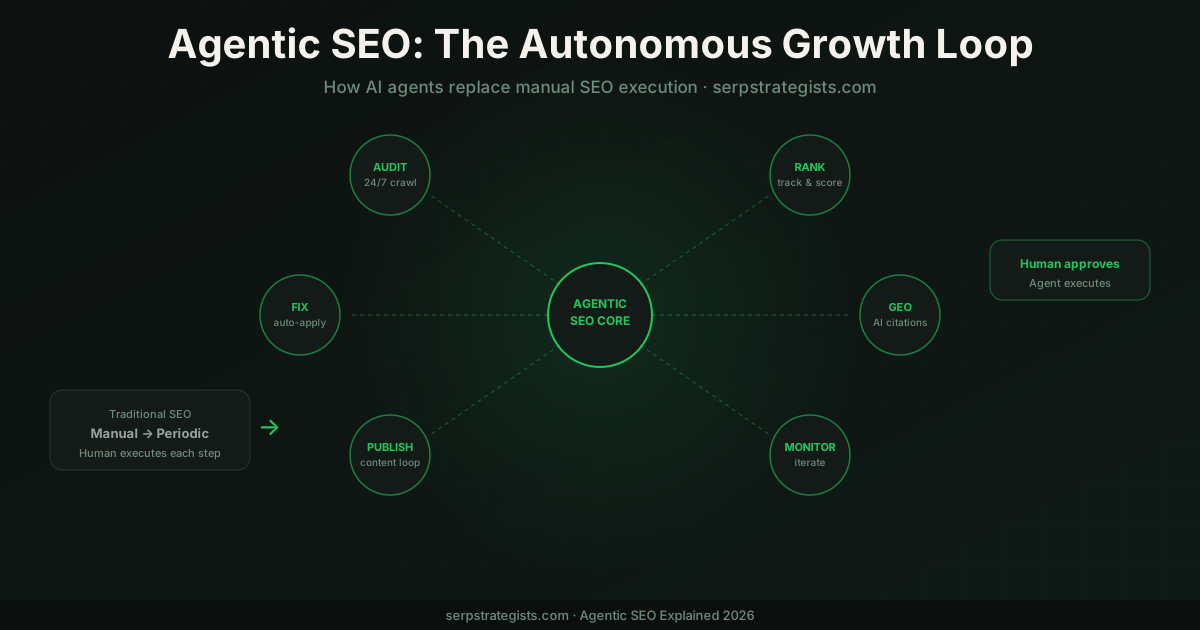
Here’s the short version: agentic SEO means using AI agents — autonomous software systems that can plan, execute, and iterate without waiting for a human to trigger each step — to run the full SEO execution workflow. The agent audits, fixes, publishes, monitors, and adjusts. Continuously. Without a monthly meeting or a ticket queue.
Agentic SEO defined: Agentic SEO is the practice of deploying AI agents to autonomously execute SEO tasks — site auditing, technical fixes, content refresh, schema updates, internal linking, and AI citation monitoring — in a continuous loop. Unlike traditional SEO automation that runs scripts on command, agentic SEO systems self-direct: they determine what needs to be done, execute the appropriate processes, evaluate outcomes, and decide next steps without human initiation of each task.
What changed in 2026
Google's AI Mode is rolling out to hundreds of millions of users. Microsoft launched Web IQ — APIs that let AI agents access Bing's index. Perplexity is processing transactions directly in search results.
The shift is simple: your website used to serve humans who searched Google. Now it also serves AI agents who browse the web autonomously.
What is Agentic SEO exactly?
Traditional SEO requires a human to read audit reports, decide what to fix, write or brief content, deploy updates, and check whether they worked. Agentic SEO replaces each of those discrete human steps with a continuous autonomous loop.
Here’s how the two models compare:
| Dimension | Traditional SEO | Agentic SEO |
|---|---|---|
| Audit frequency | Monthly or quarterly | Continuous |
| Fix deployment | Human-triggered via ticket | Agent-applied through approval gate |
| Content refresh | Scheduled campaigns | Ongoing, priority-scored |
| Schema updates | Manual dev work | Automatic across all pages |
| AI citation tracking | Rarely measured | Native capability |
| Backlog size | Grows over time | Self-clearing |
| Human role | Executor of each task | Director of strategy and edge cases |
The agent handles the throughput. The human handles the judgment calls.
Agentic SEO does not mean “no humans.” It means humans work at a different layer — setting strategy, approving edge cases, and adjusting the agent’s thresholds — while the agent handles the volume of work that used to require a full execution team.
Why most websites fail the agent test
AI agents need three things your site probably doesn't provide:
1. Machine-readable structure
Agents don't "look" at your page the way humans do. They parse structured data. If your pricing page is a beautifully designed hero section with no schema markup, an AI agent literally cannot read your prices.
2. Clear action paths
When a user asks their AI agent "find me the best SEO tool under $100/month," the agent needs to:
- Find your pricing page
- Extract the price
- Understand what's included
- Compare it to alternatives
If your pricing is hidden behind a "Contact Sales" button, you're invisible to agents.
3. Proper authentication signals
Agents need to know: Is this a real business? Is this content trustworthy? Schema markup, clear authorship, verifiable claims — these matter more than ever.
The practical checklist
Here's what I'd do this week if I were starting fresh:
- Add JSON-LD schema to every page (Product, Organization, FAQ, HowTo)
- Make sure your sitemap.xml is current and comprehensive
- Add a
robots.txtthat doesn't block AI crawlers unnecessarily - Put pricing, features, and key facts in plain text — not just images or PDFs
- Add FAQ sections with structured data to high-value pages
- Test with Google's Lighthouse "agentic readiness" report (yes, that's a real thing now)
Is your site optimized for the AI search era?
Most sites are completely invisible to LLM crawlers. Get a free, comprehensive AI Search Visibility & GEO Assessment to see how ChatGPT, Claude, and Perplexity cite your brand, and receive a step-by-step roadmap to capture AI search share.
- Live citation share report (ChatGPT, Claude, Perplexity)
- Content formatting audit for LLM extraction
- 3 high-impact GEO actions you can run today
The opportunity nobody's talking about
Here's what excites me: while everyone's panicking about AI stealing traffic, the real winners are sites that work well with AI agents.
Think about it. If an AI agent can easily extract your product info, understand your pricing, and trust your brand — it'll recommend you to users. That's a new acquisition channel that most of your competitors are completely ignoring.
The websites that embrace the agentic web early won't just survive. They'll get recommended by every AI assistant on the planet.
What we're doing about it
At SERP Strategists, our agent automatically adds the structured data, schema markup, and machine-readable content that makes your site agent-ready. It's not extra work on your plate — it happens as part of the standard SEO optimization.
Because honestly? In 6 months, "agentic readiness" won't be an edge. It'll be table stakes.
Frequently Asked Questions: Agentic SEO
What does agentic SEO mean?
Agentic SEO means using AI agents to execute SEO tasks autonomously — not just recommending what to do, but actually doing it. An agentic SEO system can audit a site, prioritize fixes, generate content updates, apply schema markup, monitor results, and adjust its own workflow based on what is working. It is the shift from AI as advisor to AI as operator.
Is agentic SEO different from AI SEO tools?
Yes. AI SEO tools assist with individual tasks: writing assistants, keyword research tools, audit analyzers. Agentic SEO is more specific and more powerful: AI that completes a multi-step workflow without waiting for a human to advance each piece. AI SEO generates a list of meta descriptions. Agentic SEO generates them, formats them, applies them to the pages, monitors the CTR impact, and adjusts priority accordingly.
Will SEO become fully automated?
The execution layer of SEO — auditing, fixing, refreshing, monitoring — will become largely automated by agentic systems. The strategy layer — brand positioning, creative direction, link building relationships — will remain human-led. The middle layer of repetitive execution work, which currently consumes most of the time on SEO teams, is what agentic systems are systematically replacing in 2026.
What is the difference between agentic SEO and SEO automation software?
SEO automation software runs scripts on command: generate these 500 meta descriptions, check these 200 redirect chains. Agentic SEO systems are self-directed: they determine what needs to be done, run the appropriate processes, evaluate the outputs, and decide next steps without a human triggering each step. The key difference is initiative — automation software waits to be run, agentic systems run themselves.
Is agentic SEO safe? What governance controls exist?
Agentic SEO is safe when the agent operates through a human-approved workflow rather than applying changes directly without review. The standard governance model is: agent proposes changes, human approves or rejects, agent deploys approved changes. All changes are logged with timestamps, diffs, and rollback capability. This is how SerpStrategists operates — the agent never applies changes without an approval gate. Read more about the execution model at Governance.
Not sure if your site is agent-ready? Run a free audit — our AI checks your structured data, schema coverage, and agentic readiness automatically.
Compare the best AI SEO tools for 2026
Choosing between SEO platforms, content optimizers, AI visibility trackers, and execution tools? Read Best AI SEO Tools in 2026: 12 Tools Compared for a use-case comparison covering pricing models, strengths, limitations, and the best fit for SaaS teams.
From search insight to shipped execution
SEO platforms and AI assistants can surface opportunities, but the work still needs prioritization, approval, execution, validation, and measurement. See how the SERP Strategists AI Growth Operator turns search data into governed, reviewable actions instead of another reporting backlog.
Done reading? is your site optimized for the AI search era?
Most sites are completely invisible to LLM crawlers. Get a free, comprehensive AI Search Visibility & GEO Assessment to see how ChatGPT, Claude, and Perplexity cite your brand, and receive a step-by-step roadmap to capture AI search share.
- Live citation share report (ChatGPT, Claude, Perplexity)
- Content formatting audit for LLM extraction
- 3 high-impact GEO actions you can run today
Written by

Aadil Khan
Founder & Organic growth operator
Aadil Khan is the founder of SERP Strategists. As an organic growth operator, he works with B2B SaaS and startup teams to scale search visibility using semantic engineering and data-driven GEO. Follow his experiments on LinkedIn or read our about page to see how we build.
How we build